Table of Contents
An MPCB can protect a motor well on its own. Yet its full value shows when it is used with suitable accessories. These additions improve control, increase safety, and make operation easier.
Some accessories expand monitoring, such as auxiliary contacts. Others, like shunt releases, allow remote operation. Protective enclosures add another layer of safety in harsh environments. Each part plays a clear role.
When you understand how these elements work together, it becomes easier to build a dependable and efficient motor control system. Now, let’s explore the MPCB accessories that have the most impact in daily use.
What is a Motor Protection Circuit Breaker?
A Motor Protection Circuit Breaker (MPCB) is a device built to protect electric motors from damage. It cuts off the power automatically when faults occur, such as overload, short circuit, or phase failure.
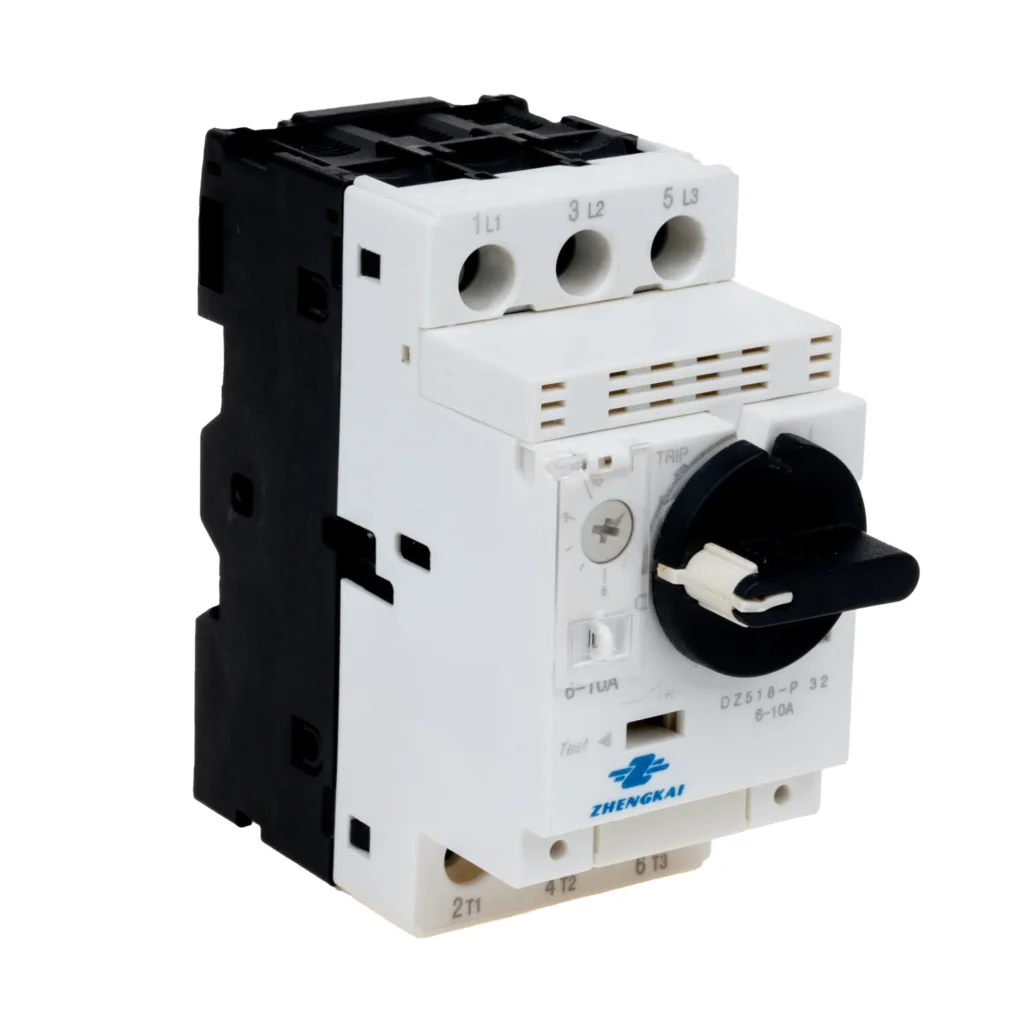
This compact unit combines switching, overload protection, and short-circuit protection in one device. It helps stop motors from overheating or burning out. Unlike standard circuit breakers, an MPCB can handle the high starting current of motors without tripping unnecessarily.
What are the Important MPCB Accessories and their Functions?
Adding the right accessories to a Motor Protection Circuit Breaker (MPCB) greatly extends its capabilities. These components improve monitoring, enable remote or automatic tripping, simplify wiring, and increase safety in both industrial and commercial motor systems.
1.Auxiliary contacts and signaling contacts
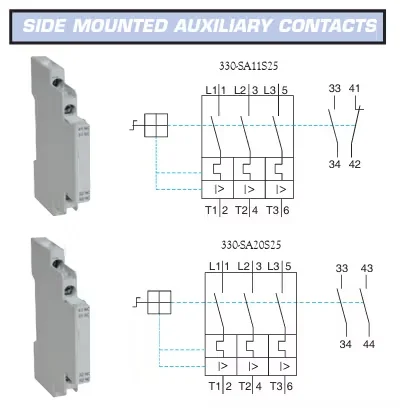
Auxiliary contacts give a remote indication of the MPCB status and supply feedback to control circuits. They are small switch blocks mounted on the breaker that change state when the MPCB is switched on, off, or trips.
Side-mounted versions attach to the side of the MPCB to save panel depth, while front-mounted types clip onto the front where side space is limited. These contacts may be normally open (NO) or normally closed (NC). Trip signaling contacts, often marked SD or OF/SD, clearly show that the breaker has tripped due to a fault rather than being turned off manually. Their outputs can be wired to indicator lights, PLC inputs, or other monitoring devices to provide clear visual and automatic feedback.
2.Releases (shunt and undervoltage)
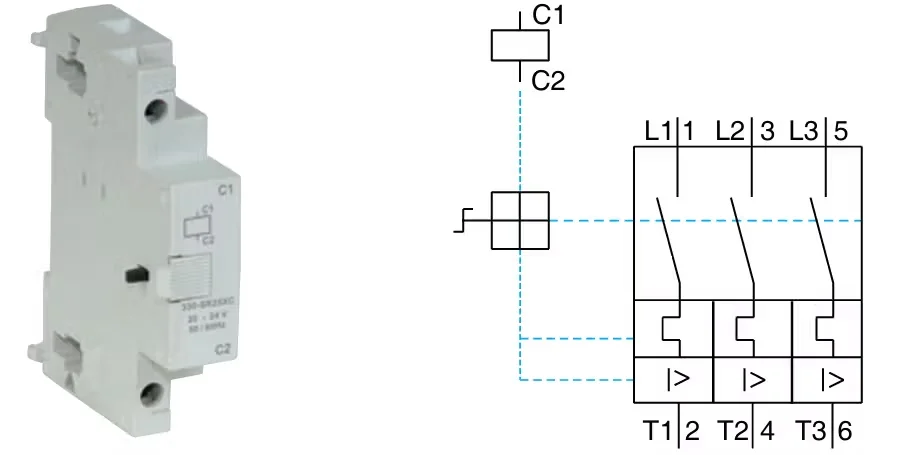
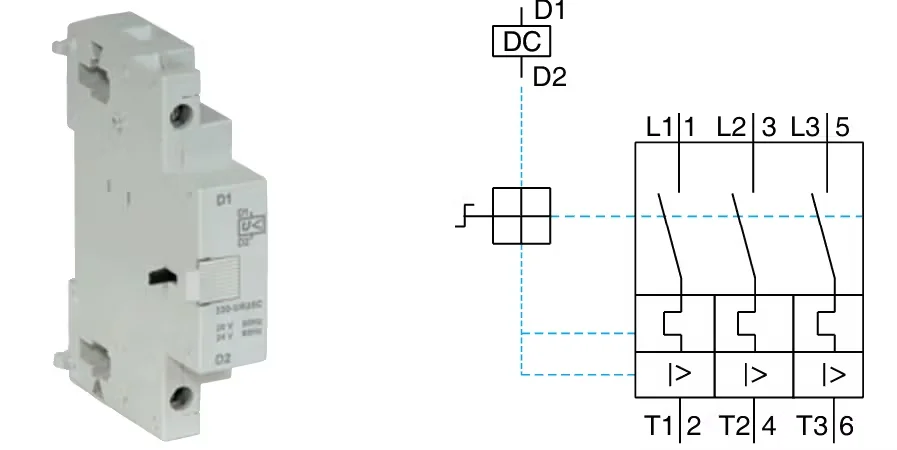
Release units are electromagnetic devices that trip the MPCB under certain electrical conditions, allowing remote or automatic shutdown.
Shunt releases allow a breaker to be tripped from a distance by applying a control voltage to a coil, making them useful for emergency stop buttons, interlocks, or control system shutdown commands. A dedicated control circuit energizes the shunt trip coil, which then mechanically opens the breaker, and versions are available for a wide range of AC and DC control voltages (for example 24–48 V AC/DC or 110–415 V AC).
Undervoltage releases (UVR) trip the MPCB when supply voltage falls below a set level so the motor does not restart unexpectedly after a power loss. The UVR coil must stay energized for the MPCB to remain closed; if voltage drops too low, the coil releases and the breaker opens. UVRs are offered for common control voltages such as 24 V DC or 220 V AC.
3.Operating mechanisms and handles
External operating mechanisms let users control the MPCB safely from outside an enclosure.
Extended rotary handles mount on the panel door so the breaker can be turned on or off without opening the cabinet, keeping personnel away from live parts. They often use a red/yellow color scheme, may carry IP65 ratings for dust and water resistance, and typically include a door interlock that stops the door from being opened while the MPCB is in the ON position.
Some MPCBs also support push-button operation, with add-on parts for emergency stop functions and options for lockable covers to prevent unauthorized use.
4.Connection accessories and busbars
Connection accessories make it easier to integrate MPCBs into larger motor control assemblies.
Connecting links and conductors are used to join an MPCB to a contactor, forming a compact motor starter with fewer separate wires and reduced panel space. Busbars (commoning links) distribute power from a single source to several MPCBs mounted on a DIN rail, replacing multiple individual feeders and resulting in a neater and more reliable installation. These busbars are available in different 3‑phase layouts and sizes to fit various breaker and accessory combinations.
5.Enclosures
When an MPCB is used outside a main panel, an individual enclosure provides the needed protection.
Surface-mounted enclosures shield the breaker from dust, moisture, and other environmental risks. They may offer a clear window for visual inspection and are often rated by IP class to show their protection level. Some designs also accept an MPCB with an external rotary handle to allow safe operation from the front of the box.
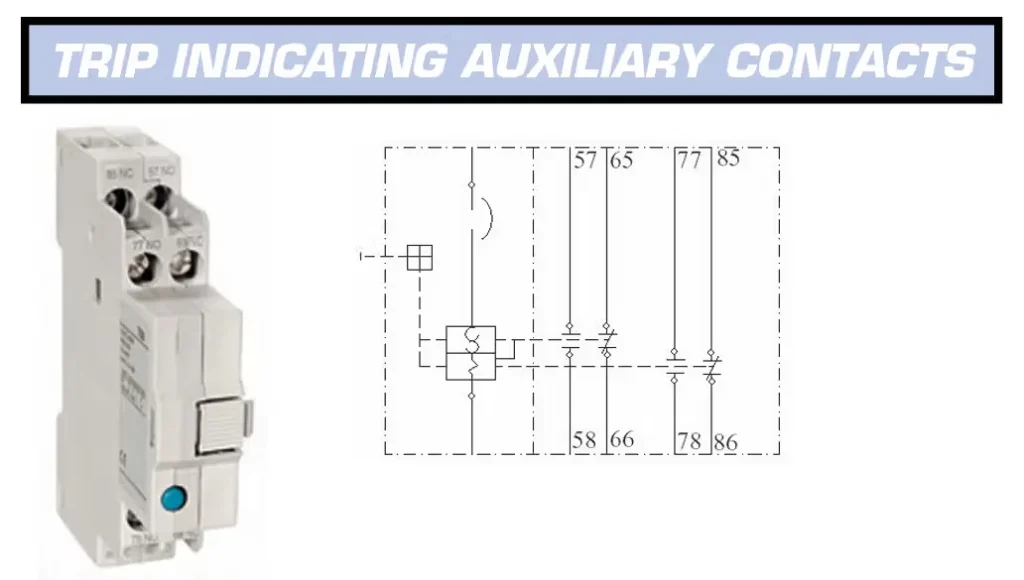
6.Trip indication auxiliary contact
The trip indication auxiliary contact module for Series 330‑T25S and 330‑M25S MPCBs provides both electrical and mechanical fault indication. It can be installed in the field without tools and works with standard front-mounted (330‑FA) and side-mounted (330‑SA) auxiliary contacts from the same family.
Electrically, the module has separate contact sets for overload and short-circuit conditions: during an overload only the overload contacts change state, while a short circuit causes both the overload and short-circuit contacts to change state. Mechanically, a blue button pops out after a short-circuit trip, giving a clear visual indication on the front of the device.
For Series 330‑T25S units built as Type E self-protected combination motor controllers, this trip indicating module must be used together with a line side terminal barrier. It can also be combined with other auxiliary contacts to give complete remote status information for the motor control system.
7.Line side terminal barrier
A line side terminal barrier increases the electrical clearance around incoming terminals so MPCBs can meet Type E self-protected combination motor controller safety requirements under UL 60947‑4‑1. It is field-installable on Series 330‑T25S and 330‑M25S devices.
For a Series 330‑T25S MPCB to qualify as Type E, both the line side terminal barrier and the trip indicating auxiliary contact must be installed. The barrier improves protection against accidental contact with live parts while remaining easy to fit on compatible breakers without special tools.
8.Circuit breaker – contactor link module
A circuit breaker–contactor link module connects an MPCB to a Series 300 contactor to form a solid mechanical and electrical assembly. This accessory simplifies the construction of a motor starter that can then be mounted as a single unit on one or two 35 mm DIN rails.
The module speeds up assembly by reducing separate wiring, which cuts labor and lowers the chance of wiring errors. It provides a secure, reliable connection between breaker and contactor, saves space in the control panel, and supports flexible DIN rail mounting for different layouts.
Conclusion
Motor Protection Circuit Breakers are central to keeping motors safe, but it is their wide range of accessories that truly broadens their use and performance in real-world installations. Auxiliary and signaling contacts strengthen monitoring, while shunt and undervoltage releases add smart, automatic protection to the system. Connection links, busbars, and operating mechanisms make installation cleaner and day‑to‑day operation more convenient, and enclosures and terminal barriers help meet safety codes and environmental requirements.
When you select MPCB accessories carefully and integrate them properly, you improve efficiency and also create a more dependable, responsive, and scalable motor protection system. These add-ons help cut downtime, support steady performance, and shield costly motors and equipment, which is why they have become standard components in modern motor control setups across many industries.