How to Protect a Water Pump Motor from Overload
Protect a water pump motor from overload: why pump motors overheat, how to select and set an MPCB, and which pump-specific protections to add.
Read More
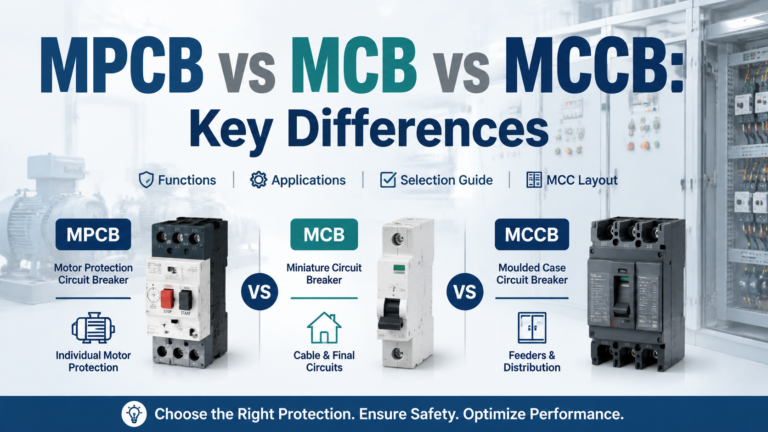
Electric motors are the backbone of industrial operations—powering everything from HVAC systems and water treatment pumps to manufacturing production lines and oil & gas compressors. Protecting these critical assets isn’t just a safety requirement; it’s a strategic investment in minimizing downtime, reducing maintenance costs, and ensuring long-term operational efficiency. When designing or upgrading motor control circuits, engineers, procurement teams, and facility managers often face a pivotal decision: Should you opt for an MPCB (Motor Protection Circuit Breaker) or a Thermal Overload Relay?
This blog breaks down the core differences, working principles, pros and cons, and ideal applications of both devices—equipping you to make an informed choice that aligns with your project’s needs, budget, and safety standards. As a trusted MPCB manufacturer with over 30 years of low-voltage electrical manufacturing experience (IEC 60947-4-1 compliant), Zhengkai Electronic shares industry insights to help you select the best protection solution for your motors.
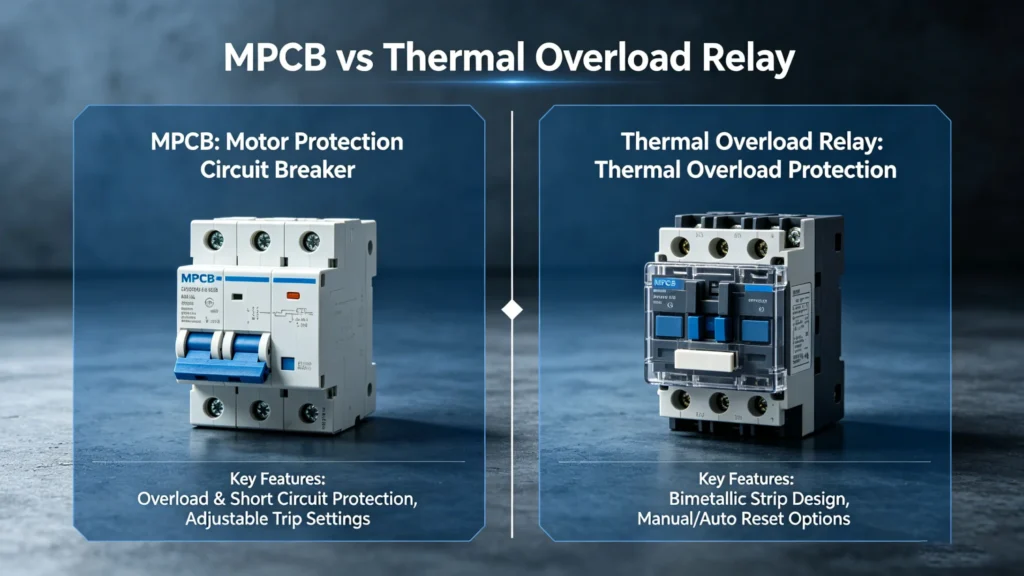
A thermal overload relay is a cost-effective, entry-level protective device designedexclusively for overload protection. Its operation relies on a simple yet reliable bimetallic strip mechanism: when an overcurrent (caused by motor jamming, voltage fluctuations, or prolonged heavy load) flows through the relay, the bimetallic strip heats up, bends, and triggers a trip signal. This trip opens the contactor, cutting power to the motor and preventing damage from overheating.
Key Note: A thermal overload relay does not provide short-circuit protection—a critical limitation. To create a complete, safe motor control circuit, it must be paired with a contactor (for motor control) and an upstream circuit breaker or fuse (for short-circuit protection). This modular setup is common in basic applications where cost is a primary concern.
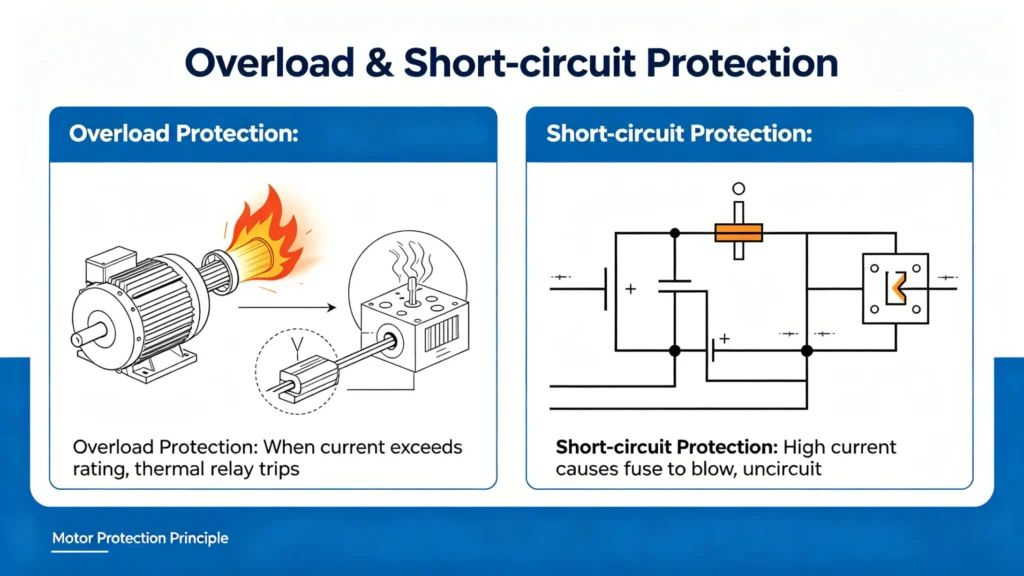
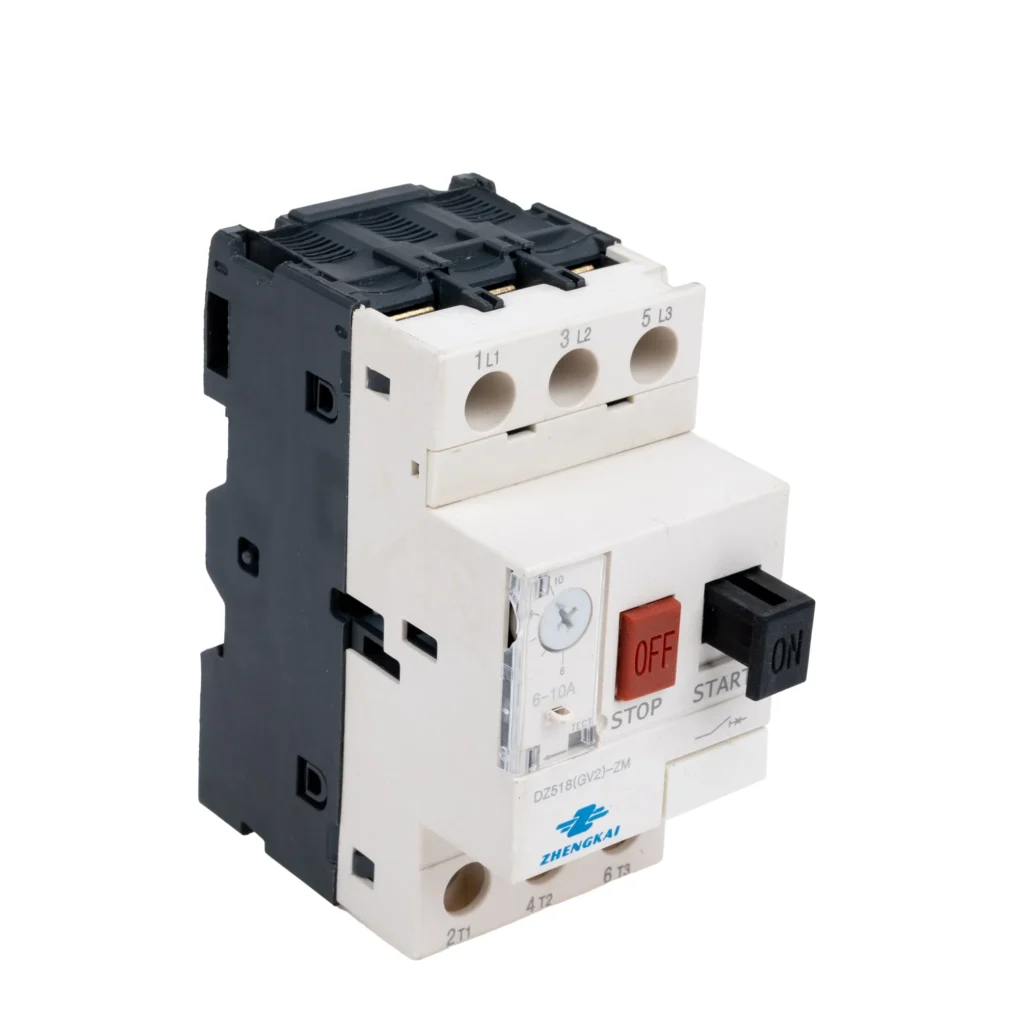
An MPCB is an integrated, all-in-one motor protection and control device that combines multiple functions into a single compact unit—eliminating the need for separate contactors, upstream breakers, and overload relays. Designed to meet global standards (including IEC 60947-4-1), MPCBs use a dual trip mechanism to deliver comprehensive protection:
Most MPCBs (including Zhengkai’s factory-direct models) also include built-in phase-loss and phase-imbalance protection—critical for three-phase motors, which are prone to burnout if one phase fails. Additionally, MPCBs feature a built-in isolation switch, allowing for safe maintenance and manual control of the motor circuit.
| Feature | MPCB (Motor Protection Circuit Breaker) | Thermal Overload Relay |
|---|---|---|
| Protection Scope | Overload + Short-Circuit + Phase Loss (standard) | Overload only |
| Short-Circuit Protection | Yes (instantaneous magnetic trip) | No—requires external circuit breaker/fuse |
| Built-in Isolation Switch | Yes (for safe maintenance) | No |
| Compatibility with Contactor | Optional (standalone operation possible) | Required (cannot operate alone) |
| Phase Failure Protection | Standard (prevents three-phase motor burnout) | Basic models: None; premium models: Optional |
| Installation Space | Compact (saves 30–40% panel space vs. modular setups) | Modular (requires extra space for contactor + breaker) |
| Upfront Cost | Higher (all-in-one design) | Lower (single-function device) |
| Total Cost of Ownership | Lower (fewer parts, faster installation, less maintenance) | Higher (extra components, labor for wiring, potential downtime from incomplete protection) |
| Safety & Reliability | Higher (fewer failure points, comprehensive protection) | Moderate (limited protection, dependent on external devices) |
✅ Pros
❌ Cons
✅ Pros
❌ Cons
The choice between an MPCB and a thermal overload relay boils down to your application’s needs, budget, and safety priorities. Thermal overload relays are a cost-effective option for basic overload protection, but they require additional components to ensure full safety and reliability. MPCBs, on the other hand, offer integrated, comprehensive protection that saves space, reduces long-term costs, and minimizes downtime—making them the preferred choice for most industrial motors and modern control panels.
At Zhengkai Electronic, we specialize in IEC 60947-4-1 compliant MPCBs with 30+ years of manufacturing experience. Our factory-direct, customizable MPCBs are designed to meet the unique needs of global OEMs, distributors, and industrial projects—delivering stable quality, competitive pricing, and reliable long-term supply.
Need help selecting the right motor protection solution for your project? Whether you’re choosing between an MPCB and a thermal overload relay, or need sizing, samples, or technical support, our team is here to help.
Visit our website: https://zk-ele.com/ | Contact our team today for personalized assistance and competitive pricing.
MPCB provides both overload and short circuit protection, while a thermal relay only handles overload. From a protection scope perspective, MPCB covers more fault scenarios.
Yes, in many applications. However, if your system requires frequent switching or automation control, a contactor may still be needed.
Mainly because they are part of traditional motor starter designs. In retrofit situations, replacing them may not be necessary.
For new designs, MPCB is often preferred due to simpler wiring and integrated protection.
Generally yes. Fewer components mean fewer failure points and less time spent troubleshooting.