Electrical Distribution Box Sizes: How to Choose Space for Breakers and Wiring
Electrical distribution box sizes: learn to allow for breakers, wiring, cable entries, depth, heat and maintenance when choosing an enclosure.
Read More
An MCCB datasheet may show a rated current of 160 A and a short-circuit breaking capacity of 25 kA. Those numbers describe different duties. The rated current relates to the circuit the breaker carries and protects in normal service; the kA figure relates to a short-circuit fault the breaker may have to interrupt. When two kA ratings appear, the distinction between Icu vs Ics matters.
Under the IEC 60947-2 framework, Icu means rated ultimate short-circuit breaking capacity and Ics means rated service short-circuit breaking capacity. Both must be read at the relevant rated operational voltage. This guide explains what each rating tells a buyer, how to compare them, and what else to verify before specifying a molded case circuit breaker (MCCB). For the wider picture, ZKELE also has a moulded case circuit breaker guide covering types, operation and maintenance.
| Rating | Meaning | Practical question |
|---|---|---|
| Icu | Rated ultimate short-circuit breaking capacity | Can this breaker interrupt the prospective short-circuit current at the stated voltage under its specified test conditions? |
| Ics | Rated service short-circuit breaking capacity | What short-circuit level has the breaker been tested to interrupt while meeting the additional operational checks associated with the service-capacity test? |
Ics may be stated directly in kA or as a percentage of Icu. Never infer a model’s Ics from its Icu alone: check the manufacturer’s table for the exact breaker variant, voltage, pole arrangement and applicable standard.
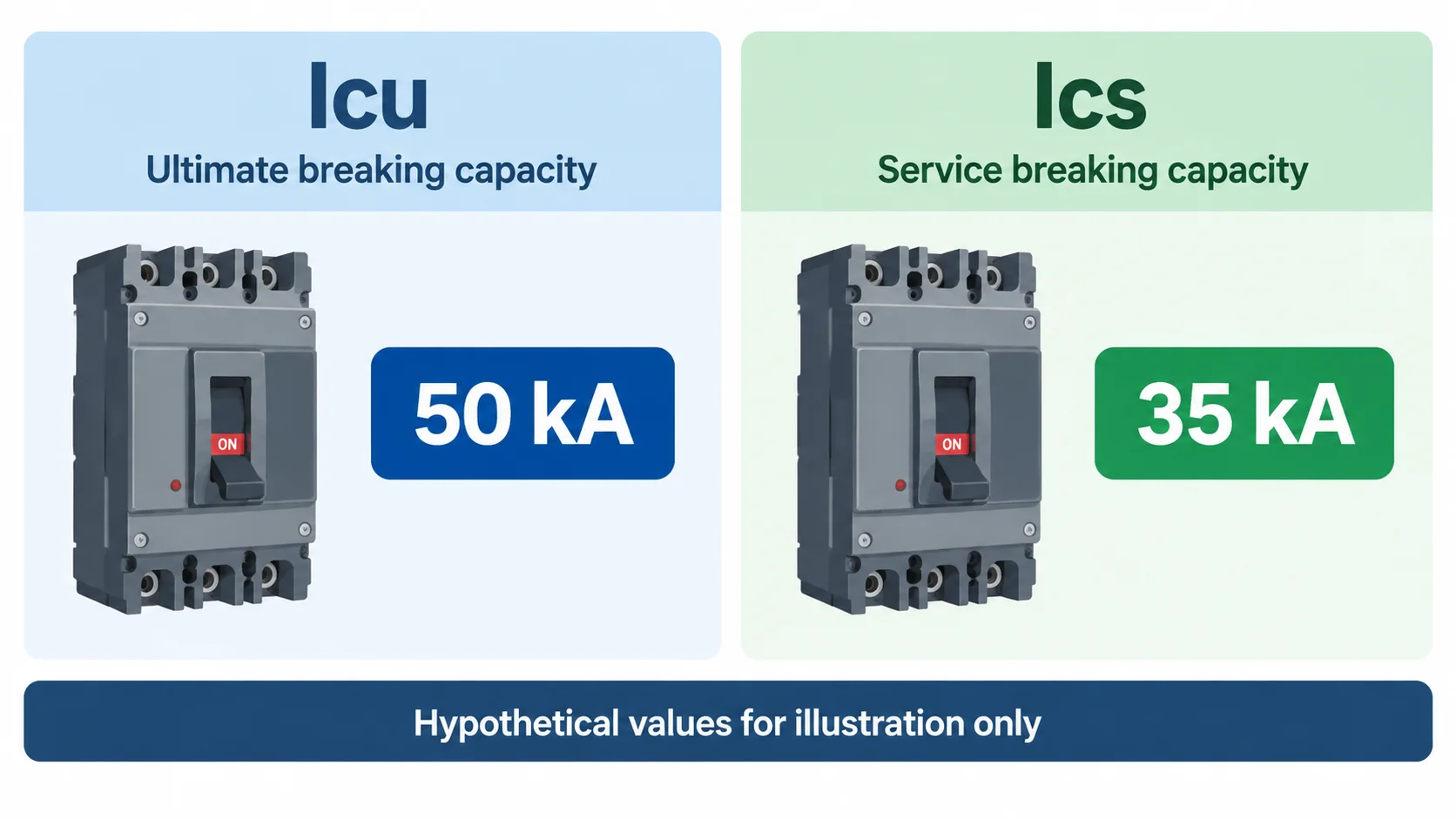
Icu is the ultimate short-circuit breaking capacity determined using the specified IEC 60947-2 test sequence. It is expressed as a prospective fault-current value in kA at a stated operational voltage. An MCCB must have adequate breaking capacity for the available short-circuit current at its installation point.
For example, a datasheet might give one Icu at 230 V AC and a different Icu at 415 V AC. You cannot use the more favorable figure for a circuit operating at the other voltage. Always read the complete rating row and confirm the actual system conditions.
An Icu value is not the breaker’s continuous current rating or the setting at which its overload element trips. A 160 A MCCB may have a short-circuit rating expressed in thousands of amperes because an electrical fault can create current far above normal load current.
Ics is the service short-circuit breaking capacity under IEC 60947-2. Its specified test sequence includes additional checks of operational capability, temperature rise and overload release. It offers information about the breaker’s tested performance after interrupting faults at the stated service level.
Some datasheets express Ics as a share of Icu. As a purely illustrative calculation, if a hypothetical breaker is rated Icu 25 kA and its declared Ics is 50% of Icu at the same voltage, its Ics is 12.5 kA. These figures are not ratings for a ZKELE model. Actual values must come from the exact product datasheet.
Even when the prospective fault current is within Ics, an actual short-circuit event still calls for the manufacturer’s inspection and maintenance instructions. A service rating does not mean a tripped breaker should be reset blindly or that damaged equipment can be put back into service without checking the fault.
The Icu and Ics test sequences have different acceptance criteria. Icu addresses the ultimate interrupting capability; Ics is associated with the additional operational checks specified for service breaking capacity. The manufacturer declares the ratings for a particular breaker configuration and voltage.
An MCCB can have Ics equal to Icu, or a lower Ics percentage, depending on its tested and published ratings. Do not assume that all MCCBs share the same percentage, or that a higher Icu automatically means a higher Ics for every competing model.
For a purchaser comparing two breakers, the useful information is a complete pair of values at the actual circuit voltage. A catalog headline such as “50 kA breaking capacity” is not enough if it does not identify the relevant rating and voltage.
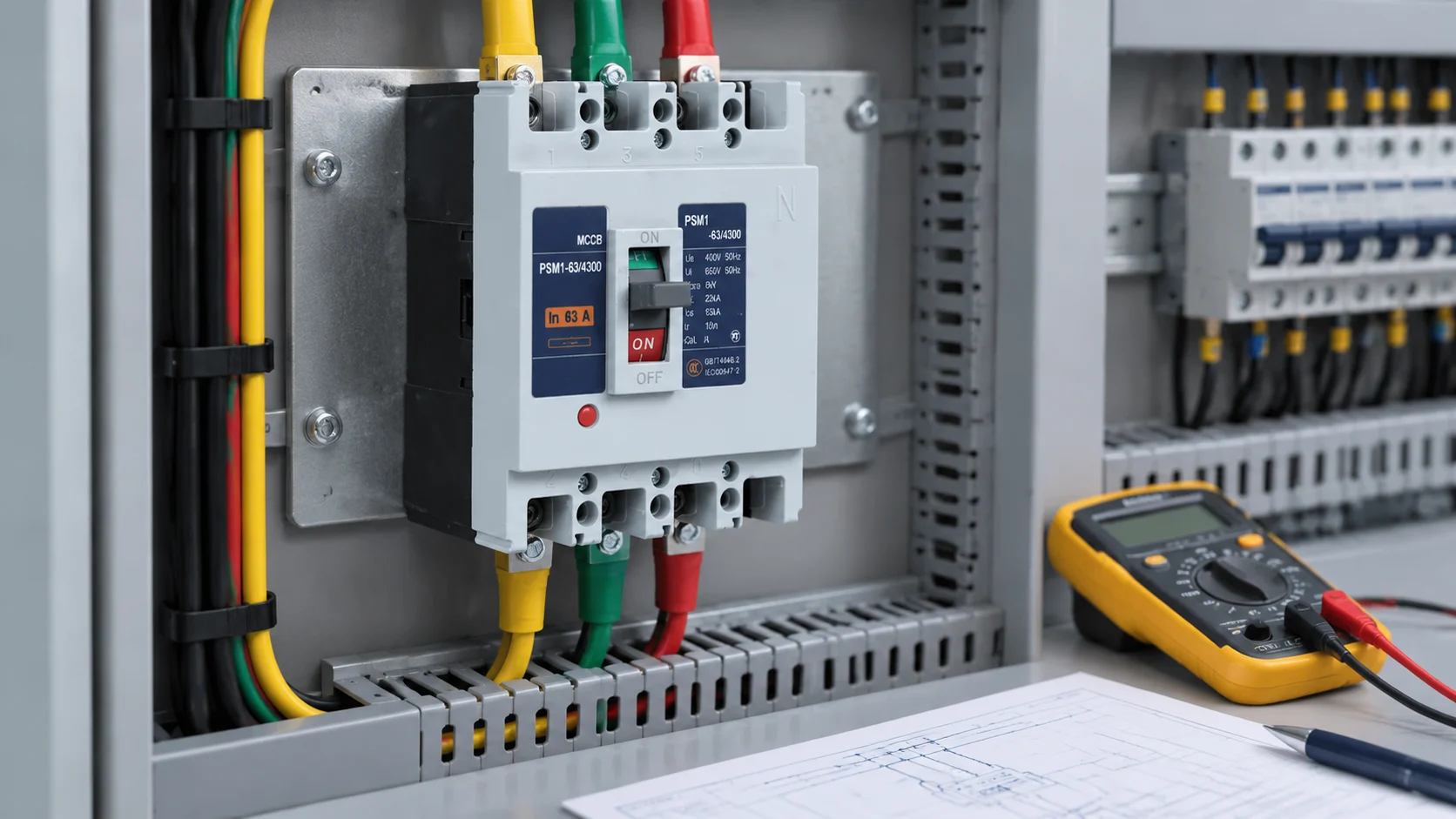
Determine the maximum prospective short-circuit current at the breaker’s installation point using the project’s electrical design or short-circuit study. Do not assume it is the same throughout a distribution system. Transformer characteristics, conductors and upstream network conditions all affect the value.
Read the Icu and Ics values for the actual AC or DC system, operational voltage, and configuration. If the datasheet lists multiple voltage rows, use the applicable row rather than the largest number on the page.
The selected breaker needs adequate rated breaking capacity for the prospective fault current at its point of installation. If an upstream protective device is being used to support a lower downstream rating, rely on a manufacturer-tested combination or coordination data, not an unsupported assumption.
Review Ics in addition to Icu, especially where short-circuit performance and subsequent operational capability matter to the project. If a prospective fault level exceeds a candidate’s Ics but remains below its Icu, this distinction deserves engineering review; it is not a reason to ignore the short-circuit rating or promise immediate return to service after a fault.
Icu and Ics do not settle the whole specification. Also check rated current, trip unit and settings, number of poles, isolation suitability, mounting, environmental conditions, selectivity requirements and the applicable product standard. Refer to the exact model documentation for each item.
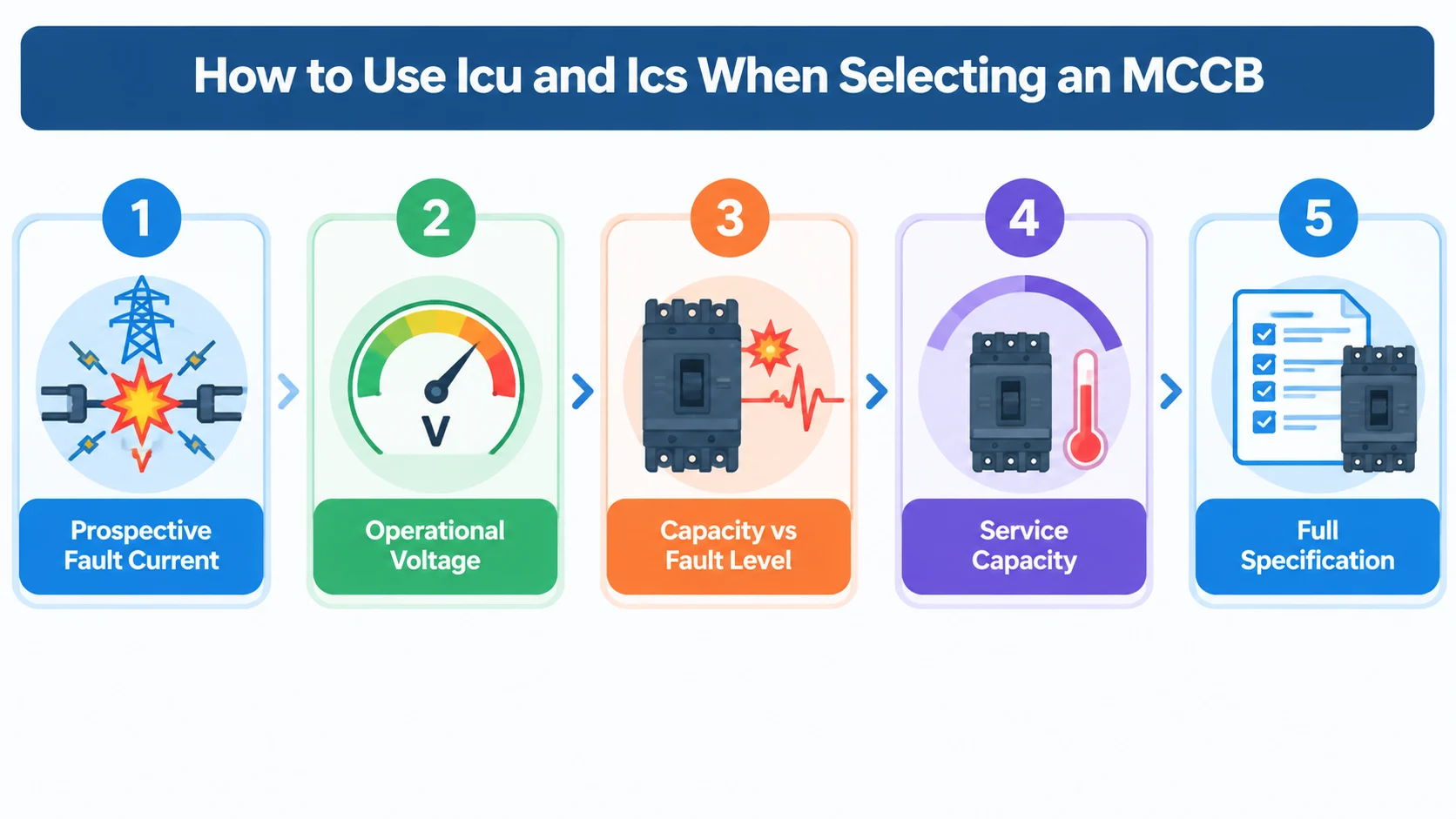
Consider a panel with a calculated prospective fault current of 18 kA at 415 V AC. Suppose a hypothetical breaker is listed at Icu 25 kA and Ics 12.5 kA at 415 V AC. Its Icu exceeds the calculated 18 kA, but its Ics is below that level. The engineer must evaluate the service requirement, applicable design rules and available breaker alternatives before choosing the device.
A second hypothetical breaker listed at Icu 25 kA and Ics 25 kA at 415 V AC has a different declared service capacity despite sharing the same Icu. Neither example describes ZKELE stock or a guaranteed choice for the project. They show why a buyer should request both ratings instead of comparing a single kA number.
For a reliable model comparison, ask for a datasheet identifying:
ZKELE offers molded case circuit breakers for distribution applications. Send the circuit voltage, rated load current, calculated prospective fault current and project requirements when requesting a model recommendation. Confirm the model-specific Icu and Ics values in the manufacturer’s technical documentation before procurement. If you are still comparing protection families, the MPCB vs MCB vs MCCB comparison and the MCCB breaker basics article explain where an MCCB fits.
No. Ics may equal Icu or be declared at a lower percentage. Check both values for the exact breaker and operating voltage.
Not automatically. Establish whether 25 kA refers to Icu or Ics, confirm the voltage and installation conditions, and compare the value with the prospective fault current at the breaker location.
Rated current concerns the breaker’s normal circuit duty. Breaking capacity concerns its ability to interrupt a short-circuit current under specified conditions. They use different units: usually A for rated current and kA for breaking capacity.
No automatic conclusion follows from the number alone. Investigate the fault and follow the manufacturer’s post-fault inspection and replacement instructions before returning the circuit to service.
The practical difference in Icu vs Ics is the difference between a breaker’s ultimate interrupting rating and its tested service breaking capacity. Read both at the correct voltage, compare them with the project fault study, and request the exact model datasheet. For a project quote, browse ZKELE’s MCCB product category and send the electrical specifications needed for model selection.