Distribution Boards for the UAE: Heat, IP Rating and G-Mark
A practical guide to distribution boards in the UAE and Gulf: the 40 °C service condition, device derating, IP rating for sand and salt, and where G-Mark and SABER apply.
Read More
A distribution board in the Philippines fails inspection for reasons that have almost nothing to do with the quality of the enclosure. It fails because the neutral and ground bars were bonded together in a sub-panel, because a single-pole device was fitted on a 265 V leg, or because the board was set into a wall with no dedicated electrical space above it. Every one of those is a design detail a buyer can fix before production, and every one of them is cheap to fix at that stage.
This guide covers what the Philippine Electrical Code asks of a panel board, why the country’s voltage set produces device choices that European and Indian specifications do not, and which approvals belong to the importer rather than to the factory. If the component set is still unfamiliar, the overview of distribution box types and functions covers it before the compliance questions start.
There is no single certificate that says a panel board is approved for the Philippine market. Approval happens at three points, none of which is a product mark on the enclosure:
The enclosure itself sits outside all three, which is exactly why it is the part buyers get wrong. The installer’s compliance depends on a distribution board that has the right bars, the right space and the right device ratings. Get that wrong and the problem surfaces at inspection, when the board is already on the wall.
The Philippine Electrical Code is published by the Institute of Integrated Electrical Engineers. Much of current practice references the 2017 edition; confirm with your electrical practitioner which edition governs your project rather than assuming.
This is the single most underestimated difference between a distribution board built for the Philippines and one built for a European IEC market. The distribution utility’s published service voltages for low-voltage supply are:
| Service | Configuration | What it means inside the board |
|---|---|---|
| 230 V, single-phase, three-wire | Two live conductors plus neutral | Two-pole main and two-pole switching, not a single-pole main |
| 230 V, three-phase, four-wire | Three phases plus neutral | Four-pole main device; neutral full-sized |
| 460/265 V, three-phase, four-wire | Grounded wye, 265 V phase to neutral | Devices must be rated for 265 V to neutral, not 230 V |
| 400Y/230 V, three-phase, four-wire | Grounded wye, offered since 2006 | Closer to European practice; still four-pole main |
Nominal frequency is 60 Hz, and the distribution code allows a voltage variation of plus or minus 10%.
Two consequences follow, and both are specification issues rather than installation issues.
The 460/265 V service is the one to watch. On that system the phase-to-neutral voltage is 265 V. A single-pole miniature circuit breaker rated for 230/240 V service is being asked to clear a fault at a voltage above its rating. The usual engineering answer is to use devices rated for the phase-to-neutral voltage, or to switch the neutral with a two-pole device, so the arc is extinguished across two contacts. If your supplier quotes a board populated with single-pole devices and does not ask which service voltage applies, that question has not been considered.
The single-phase three-wire service means the main device is two-pole. A distribution board imported with a single-pole main, which is normal for a European domestic board, does not match the service. That error is visible at first inspection.
A third point is easy to miss because it is a labelling question. PEC practice and utility nominal voltage are quoted at 230 V, while a great deal of equipment in the local market is still labelled 220 V. Enclosures do not care about a 10 V difference, but the nameplate and the technical file should state one consistent rated voltage, and it should be the voltage the importer will declare. Agree it before the artwork is printed, because reprinting a nameplate is the cheapest part of the mistake and re-testing is not.
This is the failure that catches imported distribution boards most often, and it costs nothing to design out.
Under the code, metal panel board cabinets and frames must be connected to an equipment grounding conductor, with a terminal bar for grounding conductors inside the cabinet bonded to the metal parts. Grounding conductors must not be connected to terminal bars intended for the grounded neutral conductor unless the bar is specifically designated for that combined purpose — and on a sub-feeder panel board, as opposed to service equipment, the neutral bus and the ground bus must remain isolated from each other.
Translated into a purchase order, that is four requirements:
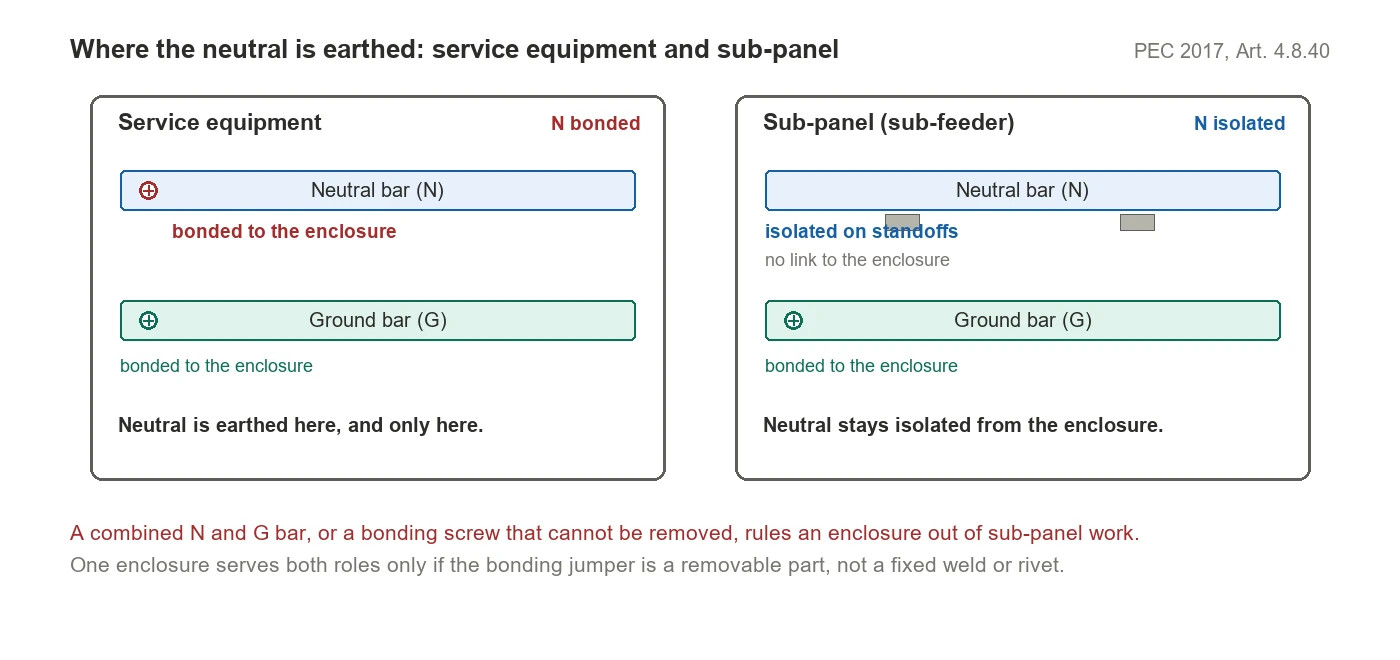
A distribution board supplied with a single combined bar and no bonding screw cannot be made compliant by the installer except by adding parts. Ask the question directly: are the neutral and ground bars separate, and is the bonding jumper removable? A supplier who cannot answer that in one sentence has not built for this market.
The code requires switchboards, panel boards, distribution boards and motor control centres to be located in dedicated spaces and protected from damage. For indoor installations the dedicated electrical space is defined as the space equal to the width and depth of the equipment, extending from the floor to a height of 1 800 mm above the equipment or to the structural ceiling, whichever is lower. No piping, ducts, leak protection apparatus or other equipment foreign to the electrical installation may sit in that zone.
Suspended ceilings with removable panels are permitted within the 1 800 mm zone, but a dropped ceiling that adds no structural strength is not treated as a structural ceiling. Where protection is installed, foreign systems may pass above the zone.
Outdoor installations are treated differently: equipment must be in suitable enclosures, protected from accidental contact by unauthorised people and from vehicles, and protected against spillage or leakage from piping systems, with working clearance maintained.
Why this matters to a buyer: the 1 800 mm rule is an architectural constraint that decides whether a wall-mounted distribution board is acceptable at all, and it changes the enclosure type. A distribution board pushed into a service corridor with a duct running above it needs either relocation or a different enclosure arrangement. On retrofits this is the most common reason a specified distribution board is rejected before installation, and no enclosure can solve it.
Two numbers shape the internal arrangement of the distribution board, and a third — the surge protective device — shapes the way count.
Interrupting rating. Circuit breakers must have an interrupting rating not less than the maximum available short-circuit current at their supply terminals, and the devices, the equipment ratings and the system impedance have to be selected and coordinated so a fault is cleared without extensive damage. The available fault current depends on the transformer and the service — the board’s location on the system, not its size. This is why a board specification that names only a frame size is incomplete: the same distribution board can be adequate at one service point and inadequate a hundred metres closer to the transformer.
The 30 A limit. A lighting and appliance branch-circuit panel board must have overcurrent protection of 30 A or less on its individual branch circuits, and the aggregate of the branch-circuit ratings must not exceed the panel board rating.
In practice that second rule produces more ways than a European board would carry for the same load, because practice in the Philippines splits general lighting, convenience outlets, and each air-conditioning unit onto separate circuits with dedicated protection. Air-conditioning load in particular is not a rounding error in a tropical climate: a distribution board sized without it will be full on day one.
The practical rule is to count ways from the load schedule and then add spare capacity for air-conditioning additions and for a surge protective device. If the way count is still open, the guidance on electrical distribution box sizes covers the method.
The Bureau of Philippine Standards, under the Department of Trade and Industry, requires products in its mandatory certification list to carry either a Philippine Standard licence or an Import Commodity Clearance before distribution in the Philippine market. The list published in the joint administrative order covering regulated imports into the Philippines names, among electrical items:
| Item | HS code reference | Requirement |
|---|---|---|
| Circuit breakers | 8535 or 8536 | PS licence or ICC |
| Fuses and fuseholders | 8535, 8536, 8536 10 | PS licence or ICC |
| Plugs and socket outlets | 8535 90 90 or 8536 69 | PS licence or ICC |
| Snap switches and knife switches | 8536 50 | PS licence or ICC |
| PVC insulated wires, cables and flexible cords | 8544 11 or 8544 20 | PS licence or ICC |
| Rigid uPVC electrical conduit | 3917 23 00 | PS licence or ICC |
An empty enclosure is not named in that list, and the same applies to an enclosure marketed in the Philippines as a distribution box. That does not mean it is exempt; it means the answer depends on how the product is classified for import, which is a tariff question rather than a product family question. Confirm it with the BPS or your customs broker against the HS code before you assume either outcome, and be aware that the list is revised — a category that is unregulated this year may not stay that way.
Two structural points about the scheme are worth knowing before you quote:
In the Philippines the honest division of labour is: the factory supplies drawings, ratings, material declarations and test reports from an accredited laboratory; the importer handles the local application. A supplier promising “PS certified, ready to ship” without naming the certificate holder and the covered models is describing something that probably does not exist in the form claimed.
The Philippines is not a single environment. A distribution board specification that works in Metro Manila is wrong in Baguio and wrong again on a Palawan coastline.
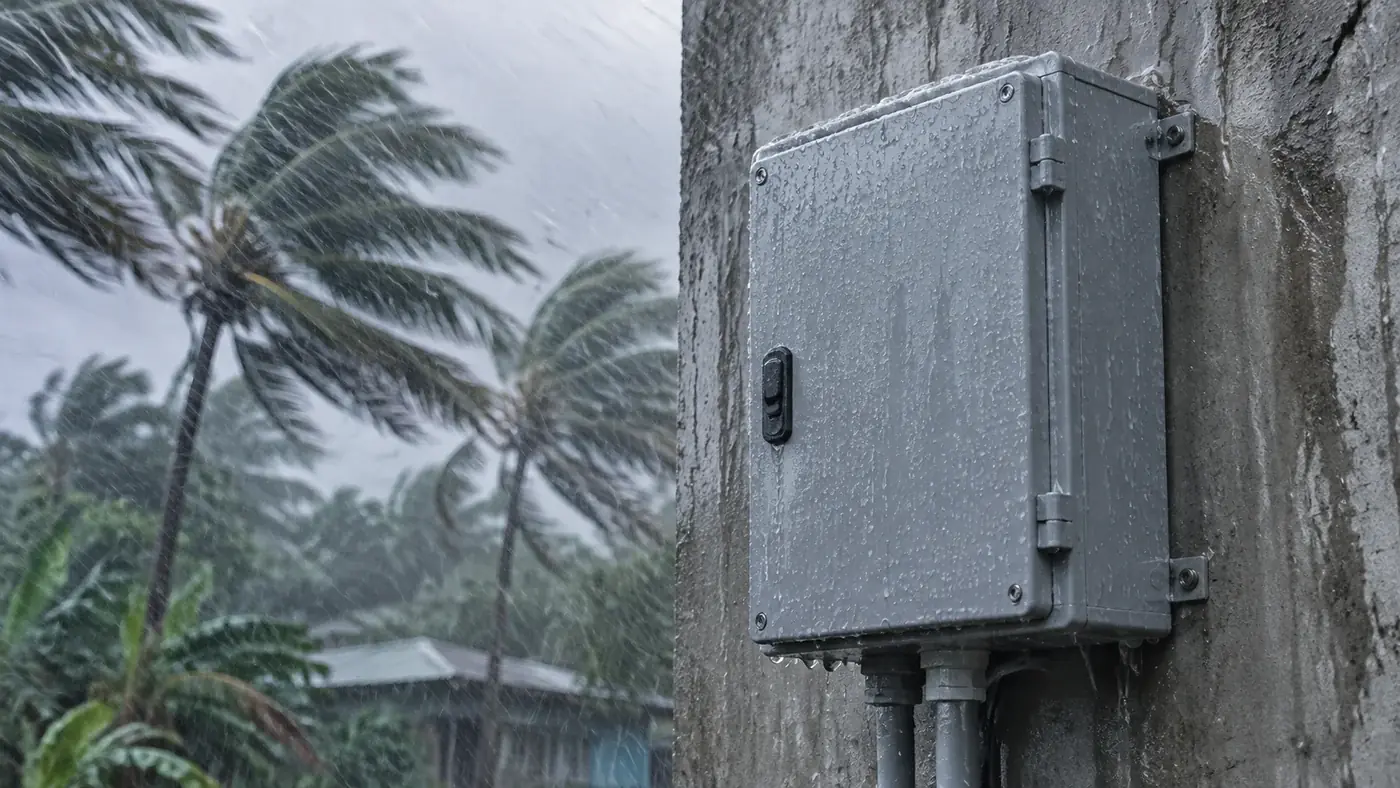
“Waterproof” is not a rating. The IP number should be traceable to a test, and IPX4, which covers splashing water, is not the same as IP65. Material choice interacts with all of this — a UV-stabilised polycarbonate board and an ABS board can carry the same IP number and still age very differently on an exposed wall — and the comparison of PVC, polycarbonate and ABS enclosures sets out where each one fails. The comparison of IP65, IP66 and IP67 for distribution boxes sets out what each level actually resists.
| Item | What to fix | Why it matters here |
|---|---|---|
| Service voltage | 230 V single-phase 3-wire, or which three-phase configuration | 460/265 V needs devices rated for 265 V to neutral |
| Frequency | 60 Hz | State it on the nameplate; affects device selection and declaration |
| Poles | Two-pole main on single-phase; four-pole on three-phase | Single-pole mains are a European default and fail inspection |
| Bars | Neutral and ground separate, both rated for the ways | Sub-panels require isolation; service equipment does not |
| Bonding | Removable main bonding jumper | Lets one enclosure serve both roles |
| Ways | Load schedule plus spare for air-conditioning and an SPD | 30 A branch-circuit limit pushes way count up |
| Interrupting rating | Matched to available fault current at the service point | Board size does not determine fault level |
| Enclosure | Material, IP rating, gland plate provision, door and lock | Outdoor exposure is a design input, not a default |
| Space | 1 800 mm dedicated space above the board, no foreign services | Architectural constraint; the board cannot fix it |
| Documentation | Drawings, ratings, material declarations, accredited test reports | The importer needs these for the ICC application |
The mandatory certification list names circuit breakers, fuses, plugs, socket outlets, switches, wires and conduit. An empty enclosure is not named, so whether a specific enclosure is covered depends on its HS classification. Confirm it with the Bureau of Philippine Standards or your customs broker rather than relying on a supplier’s statement.
Not if it is only rated for 230/240 V service. The phase-to-neutral voltage on that system is 265 V, which exceeds the rating of a device intended for 240 V. The usual answer is a device rated for the phase-to-neutral voltage, or a two-pole device that switches the neutral as well. Confirm the device’s voltage rating on its datasheet, not on the panel schedule.
Because grounding conductors may only be landed on a bar designated for the combined purpose, and on a sub-feeder panel board the neutral bus and the ground bus must remain isolated. Bonding neutral to earth at a sub-panel creates a parallel return path and is a defect, not a preference.
For indoor installations, the space equal to the width and depth of the equipment, from the floor to 1 800 mm above the equipment or to the structural ceiling, whichever is lower, is reserved for the electrical installation. Piping, ducts and other foreign systems may not occupy it.
The devices inside it do. Circuit breakers must have an interrupting rating not less than the maximum available short-circuit current at their supply terminals, and the assembly has to be coordinated so a fault is cleared without extensive damage. The available current depends on the service transformer and the board’s position on the system.
Utility nominal service voltage and code practice are quoted at 230 V, while parts of the local market still label equipment at 220 V. Pick one value, use it consistently across the nameplate, drawings and technical file, and agree it with the importer before artwork is produced. Mixing the two across documents is what causes questions at clearance.
Start with the service, not the enclosure. Establish whether the supply is 230 V single-phase three-wire or one of the three-phase configurations, because that single answer fixes the pole count of the main device and the voltage rating of everything downstream. Then count ways from the load schedule with air-conditioning and surge protection included, and specify separate neutral and ground bars with a removable bonding jumper. Material and IP rating come last, chosen against where the board is actually mounted.
If you are sourcing a distribution board for a Philippine project and want the voltage configuration, pole count, bar arrangement and IP rating checked against your single-line diagram before production, send the details and we will come back with a matched configuration. The plastic distribution box range covers the ABS and polycarbonate enclosures discussed above.