How to Protect a Water Pump Motor from Overload
Protect a water pump motor from overload: why pump motors overheat, how to select and set an MPCB, and which pump-specific protections to add.
Read More
Material choice has a direct impact on how well a small or medium-sized electronic enclosure protects the equipment inside. Compared with metal and fiberglass, thermoplastics are lighter and do not rust. However, not every plastic performs the same way, so the operating environment must be considered before selection.
Polycarbonate, ABS, and PVC are among the most common materials used for electronic enclosures. Their chemical structure, mechanical strength, weather resistance, and service life differ greatly. A material that works well indoors may fail quickly when exposed to sunlight, moisture, chemicals, or physical impact.
When evaluating ABS vs PVC and Polycarbonate, OEMs should consider more than the purchase price. Polycarbonate usually costs more than a basic PVC electrical enclosure or ABS electrical enclosure. Yet it offers stronger impact resistance, better UV stability, and greater potential to achieve IP66 enclosure protection.
These advantages can reduce cracking, premature aging, equipment damage, and replacement frequency. As a result, Polycarbonate often provides a lower Total Cost of Ownership and more reliable long-term performance in demanding industrial enclosure applications.
| Material Property | Polycarbonate | ABS | PVC |
|---|---|---|---|
| Tensile Strength | 10,000 psi | 4,500 psi | 6,300 psi |
| Impact Strength | 12 ft-lb/in | 4 ft-lb/in | 10 ft-lb/in |
| UV Resistance | Good | Poor | Good |
| Flame Rating | UL 94 5VA | UL 94 5VA with modification | UL 94 5VA |
| Thermal Aging Limit | 221°F | 140°F | 185°F |
The figures above are based on material grades selected for comparable enclosure applications.
The Polycarbonate values represent grades suitable for UL 50 or IP66 enclosure use.
The ABS data applies to grades generally intended for applications that do not require UL 50 or IP66 compliance. Modified ABS formulations may achieve a UL 94 5VA flame rating.
The PVC figures are based on grades suitable for UL 50 or IP66 enclosure applications.
Polycarbonate is a uniform thermoplastic made from one primary polymer structure. Its strong molecular bonds help provide high mechanical strength and stable performance over time.
ABS and PVC have different chemical structures. ABS is produced from acrylonitrile, butadiene, and styrene. PVC is mainly formed from carbon- and chlorine-based compounds.
These differences influence how each material performs in practical applications. They affect tensile strength, impact resistance, UV durability, flame performance, and resistance to long-term heat exposure.
OEM enclosure projects often require drilled cable-entry holes, precision cutouts, mounting plates, and other factory modifications. For this reason, machining performance is an important part of material selection.
PVC may release corrosive fumes during cutting or machining. ABS can also soften or melt when exposed to heat generated by high-speed tools.
Polycarbonate is easier to process accurately. It can be drilled and cut cleanly with minimal melting or gas release. This makes a custom polycarbonate box a dependable option for precise component installation, cable gland preparation, and safe factory customization.
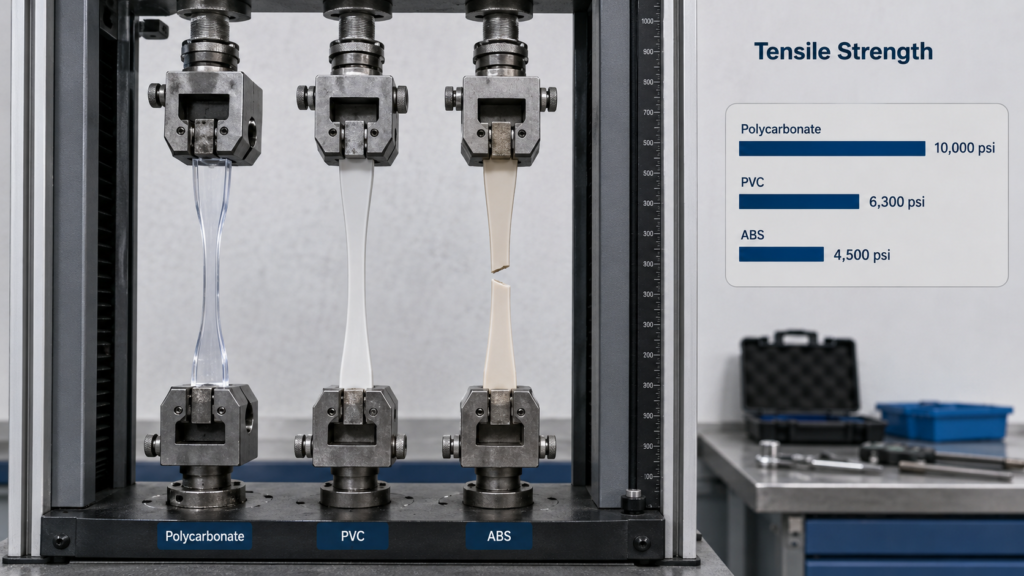
Tensile strength indicates how much pulling or external force a material can handle before it breaks or permanently deforms. This property is especially important when an enclosure must resist pressure from harsh operating conditions.
Polycarbonate provides an ultimate tensile strength of about 10,000 psi. This is more than twice the 4,500 psi rating of ABS and clearly higher than the 6,300 psi offered by PVC.
Its greater strength helps the enclosure maintain its shape and protect the components inside. This is particularly valuable in submerged installations, where the housing may need to withstand continuous hydrostatic pressure and meet NEMA 6P protection requirements.
Polycarbonate is widely used in protective glazing and safety equipment because it can absorb strong impacts without cracking easily. This same property makes it suitable for enclosure applications exposed to knocks, falling objects, vandalism, or heavy workplace activity.
Its notched Izod impact strength is approximately 12 ft-lb/in. By comparison, PVC reaches about 10 ft-lb/in, while ABS provides around 4 ft-lb/in.
This higher resistance makes polycarbonate enclosures a strong choice for outdoor sites, industrial facilities, and busy public areas. The Integra Impact Series demonstrates this level of protection by combining polycarbonate construction with NEMA 4X and IK10 ratings.
Such enclosures can continue protecting internal equipment in conditions where weaker non-metallic housings may crack, deform, or fail.
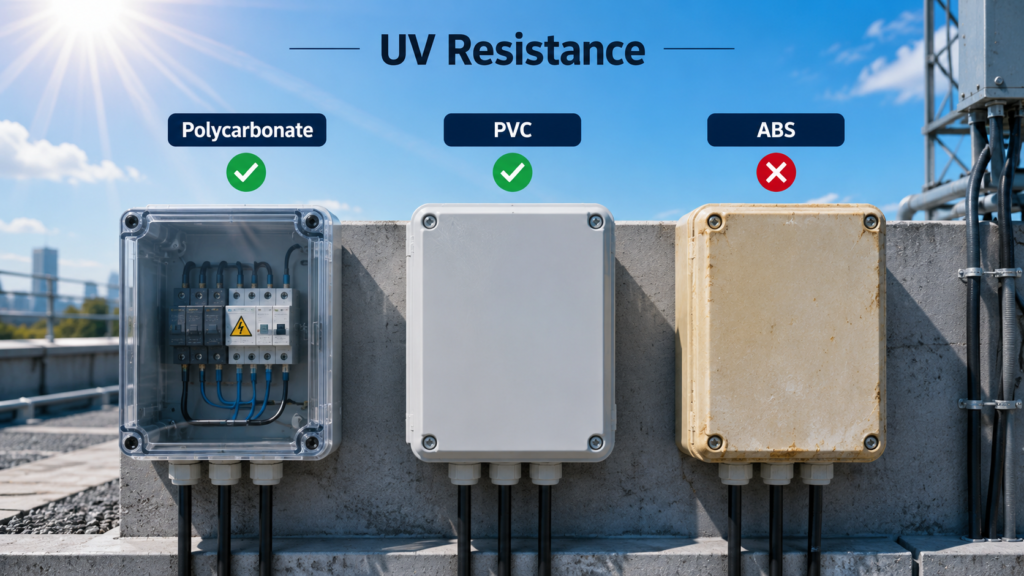
Polycarbonate and PVC both perform well in outdoor electrical enclosure applications because they can withstand prolonged exposure to sunlight.
Polycarbonate is commonly available with a UL 746C f1 rating, confirming its suitability for outdoor use. PVC is assessed differently, but it is still widely used in installations exposed to direct sunlight.
ABS offers much weaker UV stability. Continuous sun exposure can cause the material to fade, become brittle, and lose strength over time. For this reason, a standard ABS electrical enclosure is generally unsuitable for long-term outdoor deployment unless it has additional UV protection.
No thermoplastic performs equally well in every chemical environment. Polycarbonate, for example, may be damaged by certain solvents, alkaline substances, and petroleum-based chemicals.
Before choosing an enclosure material, OEMs should review a chemical compatibility chart. The selected plastic must match the liquids, vapors, cleaning agents, and atmospheric contaminants present at the installation site.
This simple check helps prevent cracking, swelling, discoloration, and premature material failure.
Polycarbonate and PVC can both achieve a UL 94 5VA flame rating, one of the highest classifications under the UL 94 standard.
Materials meeting this rating resist burn-through, do not release flaming drips, and extinguish themselves after the ignition source is removed. These properties help limit fire damage and protect the electrical components housed inside the enclosure.
ABS may also reach a UL 94 5VA rating, but it often requires a thicker enclosure wall, special additives, or protective coatings. In its standard form, ABS generally provides lower flame resistance than polycarbonate and PVC.
The Relative Thermal Index measures the highest temperature a material can withstand during long-term use without losing its key properties.
RTI testing exposes the material to elevated temperatures for approximately 5,000 to 20,000 hours. Engineers then assess changes in impact strength, electrical insulation, and overall structural performance.
Polycarbonate has an RTI rating of 221°F, giving it the strongest resistance to prolonged heat exposure among the three materials. PVC follows with a rating of 185°F, while ABS has a lower RTI of 140°F.
For electrical enclosures installed near heat-producing equipment or in high-temperature environments, polycarbonate generally offers the safest and most durable option.
Polycarbonate is naturally clear, making it easy to produce transparent covers and doors. This allows users to inspect internal components without opening the enclosure.
In the past, visibility usually required a separate viewing window. That approach adds material and assembly costs. It may also create another potential entry point for water or dust. A clear polycarbonate door provides a simpler solution.
Printed overlays can be applied to selected areas of the door. This creates a window-like effect, keeping important components visible while concealing the rest.
For branding and safety information, Integra can print directly onto the polycarbonate surface. Unlike standard labels or stickers, direct printing is less likely to peel away in demanding outdoor conditions. Logos, warnings, and operating instructions can therefore remain clear for longer.
PVC can also be produced in transparent grades, although white, gray, and black are more common. ABS is naturally opaque and usually supplied in beige, gray, or black.
Polycarbonate is well suited to demanding installations because it combines high tensile strength, strong impact resistance, UV stability, flame protection, heat tolerance, and flexible color options.
It can withstand prolonged sunlight, high-pressure water spray, rough handling, and other severe site conditions. These qualities make polycarbonate electrical enclosures a dependable choice where weaker plastic housings may crack, deform, fade, or fail.
Polycarbonate enclosures are commonly used in construction, telecommunications, marine systems, oil and gas facilities, utilities, wastewater treatment, instrumentation, remote monitoring, and renewable energy projects.
They are non-corrosive, electrically non-conductive, lightweight, and easy to machine. This simplifies transportation, customization, component installation, and on-site assembly.
Before finalizing an enclosure, OEMs should test a prototype under actual operating conditions or consult an experienced enclosure supplier. This helps confirm the correct size, protection rating, material grade, and customization requirements for the application.
ABS performs poorly under prolonged sunlight. UV exposure can cause fading, yellowing, brittleness, and gradual strength loss.
It also has lower tensile strength than polycarbonate. During machining, heat from cutting tools may soften or melt the material, making precise customization more difficult.
Yes. Polycarbonate is naturally non-conductive and provides effective electrical insulation.
When used in a polycarbonate junction box, it helps isolate energized components and reduces the risk of accidental electrical contact.
The better option depends on the installation environment. Polycarbonate offers several advantages over metal enclosures, including lower weight, corrosion resistance, and easier machining.
It can be drilled or cut without producing sparks. It also resists denting and does not require an additional protective coating to prevent rust.
For outdoor, industrial, and weatherproof applications, polycarbonate is often the strongest choice.
Compared with a standard ABS or PVC electrical enclosure, it provides a more balanced combination of impact strength, UV resistance, temperature tolerance, and long-term durability.
Electrical enclosure requirements appear across several sections of the National Electrical Code, including Article 314.
The enclosure must be suitable for its installation location and intended use. Depending on the application, this may include an appropriate listing and environmental rating, such as NEMA 4X, for protection against rain, dust, corrosion, and hose-directed water.