Distribution Boards for the UAE: Heat, IP Rating and G-Mark
A practical guide to distribution boards in the UAE and Gulf: the 40 °C service condition, device derating, IP rating for sand and salt, and where G-Mark and SABER apply.
Read More
IS 14772:2020 is the Indian standard for boxes and enclosures that house electrical accessories in household and similar fixed electrical installations. It applies to enclosures rated up to 440 V AC, used either indoors or outdoors, and it covers plastic, metal and composite constructions. In practice, this is the standard that governs the empty distribution box on the wall — not the breakers inside it.
The exclusions matter as much as the scope, because they are where buyers make expensive assumptions. The standard does not cover ceiling roses, luminaire-supporting couplers, or boxes designed as integral parts of cable trunking and ducting systems complying with IEC 61084. If you are sourcing a trunking-integrated enclosure, IS 14772 is the wrong reference and the certification route is different.
Before ordering a distribution box for India, four things decide whether the product can be sold and specified there:
The last point is the one that catches importers, and it is covered in detail below.
The most common misunderstanding in this category is treating an ISI-marked distribution box as proof that the finished board is compliant. It is not.
| What you are buying | Governing Indian standard |
|---|---|
| Empty enclosure or box | IS 14772:2020 |
| Assembled low-voltage distribution board | IS 8623, now aligned with IS/IEC 61439 |
| Circuit breakers inside the board | IS/IEC 60898 series for MCBs, IS/IEC 60947 series for other switching devices |
| How the installation is wired | IS 732, Code of Practice for Electrical Wiring Installations |
A distribution box carrying the ISI mark tells you the enclosure met its own standard. It says nothing about whether the board someone builds inside it meets the assembly standard, or whether the breakers fitted are correctly rated and coordinated. Those are separate assessments on separate products.
This distinction is not academic. A panel builder who buys a certified box and assembles a board in it still has obligations under the assembly standard, and a buyer who assumes otherwise discovers the gap at inspection. If you are specifying at board level rather than enclosure level, the difference between a distribution box and a junction box is also worth settling before the enquiry goes out — they are used and assessed differently.
Low-voltage supply in India is nominally 230 V single-phase and 415 V three-phase at 50 Hz. Older installations and older documentation often describe the single-phase value as 240 V, and equipment is commonly rated accordingly, so both figures appear in tenders. Confirm which one your project states rather than assuming.
The wiring practice for the installation comes from IS 732; the box itself comes from IS 14772. Voltage and phase decide three physical things about the box: the number of ways, the size of the neutral and earth bars, and whether the incoming device is a double-pole or four-pole incomer. A single-phase board with a DP incomer and a three-phase board with a TPN incomer are not interchangeable, and the enclosure depth differs once a four-pole device and its cabling are fitted.
| Application | Typical supply | Starting point for ways | Incomer |
|---|---|---|---|
| 1 BHK flat | 230 V single-phase | 6–8 | DP |
| 2 BHK flat | 230 V single-phase | 8–12 | DP |
| 3 BHK flat or small villa | 230 V single-phase | 12–16 | DP |
| Shop, clinic, small office | 230 V single-phase | 12–18 | DP |
| Villa or small commercial with motor loads | 415 V three-phase | 16–24 | TPN |
Treat the way counts as starting points. The correct number comes from the load schedule and the electrician’s circuit design, and Indian practice usually separates lighting, 6 A sockets, 16 A sockets, and each air conditioner or geyser onto its own circuit. Whatever the final count, add spare ways — retrofitting an enclosure in a finished wall is far more expensive than leaving two ways empty.
India does not have one enclosure problem, it has three, and a single default IP rating serves none of them well.
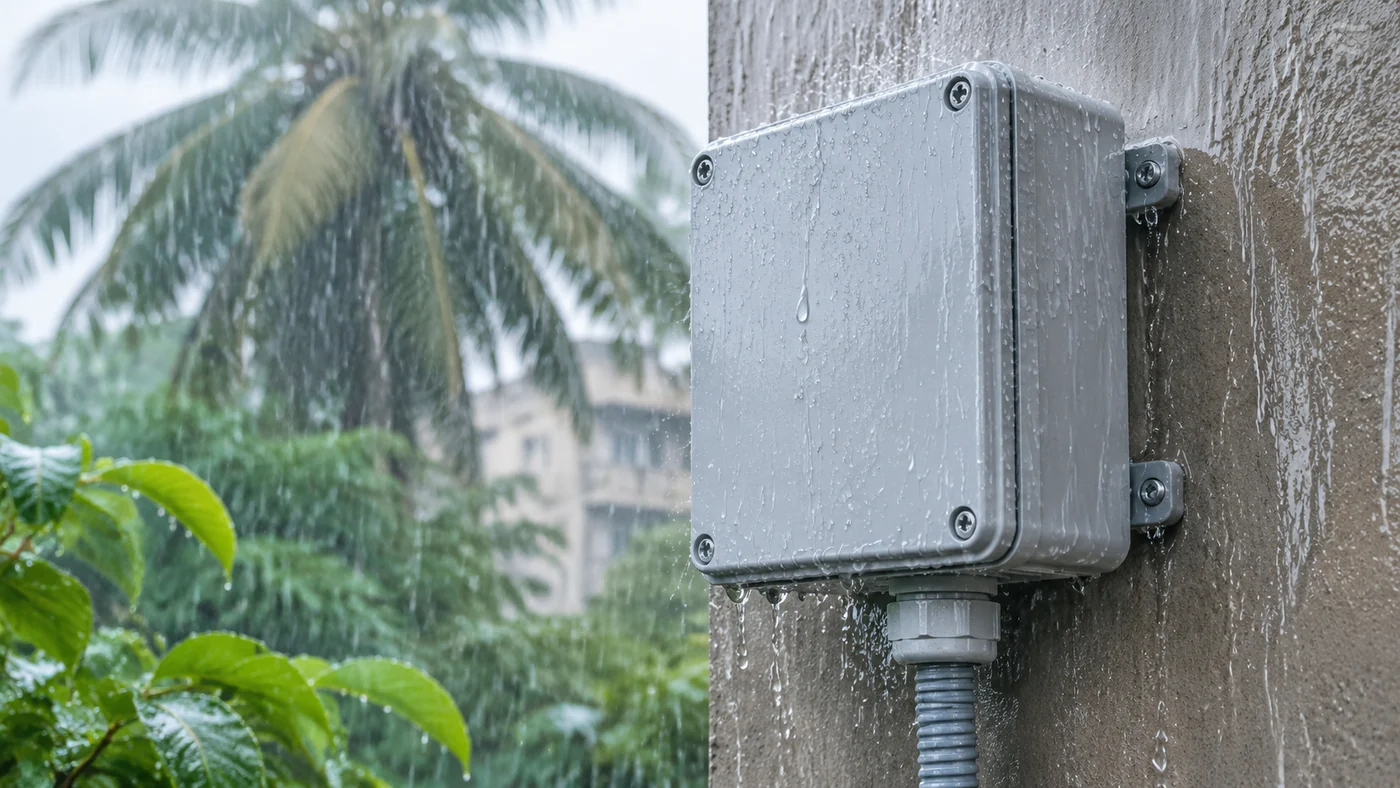
Monsoon and coastal installations — Mumbai, Chennai, Kochi, Kolkata — combine heavy seasonal rain with sustained humidity and, near the coast, salt-laden air. For a distribution box mounted outdoors or on an exposed wall, IP65 is a sensible floor. Where the box faces driving rain, IP66 is worth specifying. Salt air attacks terminal screws and unpainted steel, so on metal enclosures the pretreatment and coating system deserve as much attention as the IP number.
Northern and western dust — Rajasthan, Delhi NCR, parts of Gujarat — are dominated by fine particulate. Dust settles across breaker terminals and around terminal screws, and the failure mode is not water damage but tracking and unexplained thermal trips some months later. On these sites, sealing against solid objects matters more than water resistance, and slotted ventilation works against you.
IS 14772 assesses the enclosure’s protection against the ingress of solid objects and of water, so the IP figure on a datasheet should be traceable to a test rather than to a catalogue claim. “Waterproof” is not a rating. IPX4 protects against splashing water; IPX5 and IPX6 protect against jets at increasing pressure. A box described only as waterproof has no defined performance, and a purchase order that says only “waterproof” gives you no basis for rejection. Ask for the IP number and the standard it was tested to. The practical differences are set out in IP65 vs IP66 vs IP67 for distribution boxes.
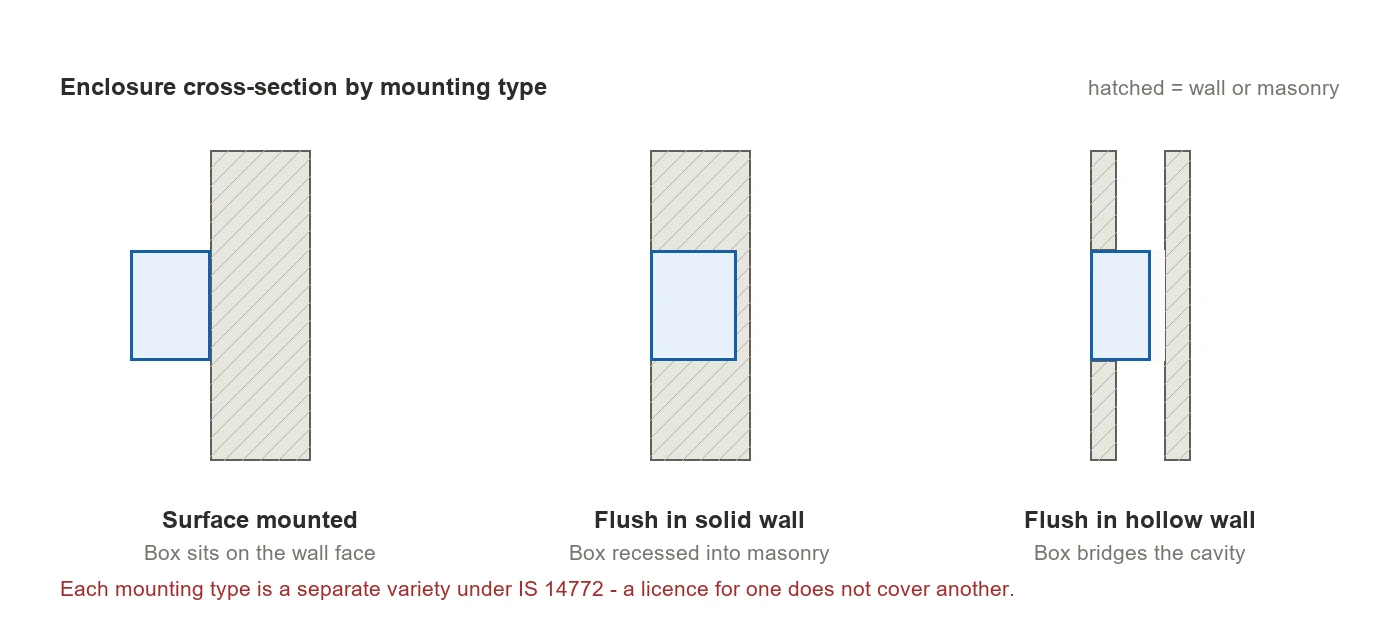
IS 14772 classifies enclosures by mounting method, and this is not a cosmetic detail — it affects what the product is certified for. The classification distinguishes surface mounting on walls, ceilings or floors from flush and semi-flush installation, and further separates flush installation in solid walls and concrete from flush installation in hollow walls, ceilings, floors or furniture.
The hollow-wall case carries its own sub-classes in the standard’s grouping rules. If a specification says “flush” without saying whether the wall is solid or hollow, the supplier cannot tell you which variety they are offering, and you cannot tell whether their licensed scope covers it. A distribution box sold as “flush mounting” without that detail is underspecified.
Material choice follows the same logic:
The trade-offs between the three, including where each one fails, are covered in PVC vs polycarbonate vs ABS enclosures.
This is where most sourcing decisions go wrong, and it is rarely explained on the pages that tell you how to apply for certification.
IS 14772 falls under the Electrical Accessories (Quality Control) Order, 2023, notified as S.O. 43(E) dated 1 January 2024 and published in the Gazette on 3 January 2024. The order came into force six months after publication, with staggered dates for smaller enterprises. It was further amended by the Electrical Accessories (Quality Control) Amendment Order, 2026, in force from 13 January 2026. Goods manufactured in India exclusively for export are exempt; imports are not.
India is unusual in naming the enclosure directly in a compulsory order. Most markets do not name it at all, and the requirement lands on the components inside and on the installation certificate instead. The Gulf is the clearest example — its technical regulation for low-voltage equipment covers appliances and accessories, but not enclosures — and the guide to distribution boards for the UAE explains where the requirement actually sits there.
The licence itself is granted to a specific manufacturing location, and it covers specific varieties — not a product category in general. The grouping rules that define a variety take into account:
The practical consequence is blunt: a licence covering a surface-mounted plastic box with no inlet does not automatically cover a flush-mounted metal box with threaded conduit entries. They are different varieties, and the second one needs to be included in the licence before it can legally carry the ISI mark.
So when a supplier says “we are BIS certified”, the useful follow-up questions are:
For a foreign manufacturer, the licence is held by the overseas factory under the Foreign Manufacturers Certification Scheme, and an Authorised Indian Representative resident in India is mandatory. Agencies generally quote about 180 days for a foreign manufacturer, against roughly 30 days for an Indian one, so the certification timeline has to sit in the project plan rather than being treated as an afterthought at shipping.
Not every market puts the licence at the centre. Where a laboratory report and a certificate attached to the shipment are enough, the timeline shortens and the application moves to the importer. Nigeria works that way, and the guide to distribution boxes for Nigeria and SONCAP covers the sequence.
| Item | What to state in writing |
|---|---|
| Standard referenced | IS 14772:2020, with the edition stated |
| Rated voltage | Up to 440 V AC, matched to 230 V single-phase or 415 V three-phase supply |
| Ways and spare capacity | Total ways, plus agreed spare percentage |
| Mounting type | Surface, flush or semi-flush; for flush, state whether the wall is solid or hollow |
| Material | ABS, polycarbonate or steel grade, with coating specification for coastal sites |
| Inlet type | Conduit size and type, cable entry, spouts, or no inlet |
| Degree of protection | The IP number and the standard it was tested to |
| Internal provision | DIN rail length, neutral and earth bar capacity, terminal rating |
| Licence evidence | CM/L number and a scope covering the exact variety ordered |
If you are still settling capacity, the guidance on electrical distribution box sizes covers how physical space relates to way count. For the wider set of enclosure types, see electrical distribution boxes: types, components and functions.
Yes, where the distribution box falls within IS 14772:2020 and the Electrical Accessories (Quality Control) Order applies. The enclosure itself is covered, not only the assembled board. Confirm the specific variety and HS code before booking production.
No. The box is assessed against IS 14772; the assembled board is assessed against the assembly standard, IS 8623 as aligned with IS/IEC 61439. The two are separate products with separate requirements.
No. IS 14772 covers boxes and enclosures for electrical accessories. IS 8623 covers low-voltage switchgear and controlgear assemblies. A board uses both, but they are not interchangeable references.
The overseas manufacturing location, under the Foreign Manufacturers Certification Scheme. An Authorised Indian Representative resident in India is required. An importer cannot hold the licence on the factory’s behalf.
No. Under IS 14772, the licence covers specific varieties grouped by material, mounting type, inlet type, clamping means and degree of protection. A differently configured box usually needs to be added to the scope first.
Treat IP65 as a floor for exposed outdoor mounting and IP66 where driving rain is expected, and give equal weight to the coating system on metal enclosures. Coastal salt air causes failures that the IP number alone does not prevent.
Fix the distribution box specification before the certification question: rated voltage, way count with spare capacity, mounting type and wall construction, inlet type, degree of protection and material. Those six items define the variety under IS 14772, and the variety is what the licence has to cover. Getting that order right saves the re-certification conversation later.
If you are specifying enclosures for an Indian project and want the mounting type, inlet configuration and IP rating checked against your load schedule and the licence scope before you commit to a production run, send the details and we will come back with a matched configuration. The plastic distribution box range covers the ABS and polycarbonate options discussed above.