Distribution Boards for the UAE: Heat, IP Rating and G-Mark
A practical guide to distribution boards in the UAE and Gulf: the 40 °C service condition, device derating, IP rating for sand and salt, and where G-Mark and SABER apply.
Read More
A distribution board in South Africa is specified by two different rulebooks at once, and most buyers only check one of them. SANS 10142-1 governs the installation the board becomes part of. The NRCS compulsory specifications govern the components that go inside it. Neither one certifies the empty enclosure you are actually importing, which is why a supplier can be fully compliant on paper and still hand you a board that fails a Certificate of Compliance inspection.
This guide walks through what the wiring code asks of the distribution board itself, why South African boards need more rail width than the same load would need in Europe, what load shedding has added since 2020, and which paperwork belongs to the importer rather than the factory.
SANS 10142-1, the Wiring of Premises, is a code of practice for installations. It tells the installer how a distribution board must be positioned, protected, labelled and tested. It does not approve products. That job sits with the National Regulator for Compulsory Specifications, which issues a Letter of Authority for categories listed in a compulsory specification.
The practical consequence is that three separate things have to line up:
Only the third item produces a legal document, and only a registered person can issue it. An imported board arrives with none of the three in place. What a supplier can genuinely do is make the first two easy: build the enclosure to suit the code, and use components whose LOA numbers the installer can verify.
If you are still working out how many ways the board needs and how the internal layout should be arranged, the overview of distribution box types and functions covers the component set in more detail than this article does.
South African low-voltage supply is 230 V single-phase and 400 V three-phase at 50 Hz. Older installations are still labelled 220/380 V, and the two nomenclatures describe the same systems.
In a domestic distribution board this produces a specific pattern: a double-pole main switch, earth leakage protection, and single-pole MCBs on the final circuits. Three-phase boards add four-pole main devices and need the neutral and earth bars sized for the full load rather than a fraction of it.
Two physical consequences matter when you are buying a distribution board enclosure rather than building the installation:
A three-phase distribution board with a four-pole main device, an earth leakage unit and a surge protective device can consume twelve modules before the first final circuit is connected. That arithmetic is the single most common reason a distribution board that looked big enough on a quotation ends up being extended within a year.
Earth leakage protection is not optional here, and the threshold is fixed. SANS 10142-1 states that the rated earth leakage tripping current required to activate the device shall not exceed 30 mA. The same standard is explicit that earth leakage protection is an additional protective measure, not a substitute for earthing and bonding.
Because the limit applies to socket outlet circuits and the code requires it on final circuits generally, a typical South African distribution board carries one or more earth leakage devices ahead of the MCBs, and each of those devices takes rail space and needs its own neutral path.
There is a detail that catches importers. Where an earth leakage device does not include integral overcurrent protection, the code requires it to be protected either by a fully rated short-circuit protective device, or by a combination whose conditional short-circuit current rating is at least 2.5 kA. That requirement is about the assembly, not the enclosure — but it changes what the panel builder has to fit, and therefore how much room the distribution board needs.
One more thing that is often mis-sold: a distribution board where the earth leakage trips above 30 mA is not automatically illegal, it has to carry a warning label stating the actual tripping current. If a supplier tells you a 100 mA device is fine for socket circuits with no label, that is not a code-compliant answer.
The 2020 edition of SANS 10142-1 added a section on alternative supplies covering generators, photovoltaic systems, inverters, wind and small hydro. For a distribution board, this is the biggest change in twenty years, and it is where most of the new rail width goes.
The requirements that affect the enclosure:
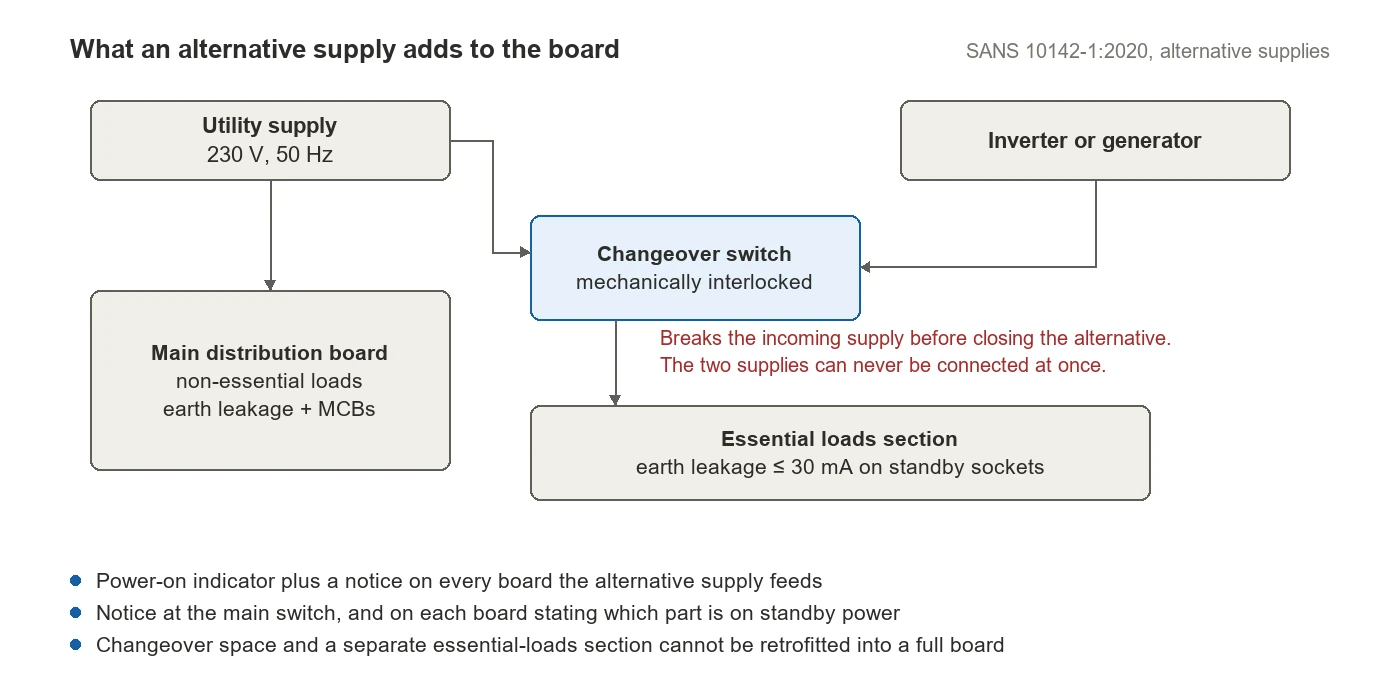
There is also a rule that surprises people who buy generators abroad. A 230 V generator whose winding is centre-tapped and earthed — the V-O-V connection — must not be connected to the fixed electrical installation at all. It may be used as a free-standing unit feeding appliances directly. A distribution board specified for a site where an unverified generator will be connected is a board waiting for a compliance failure.
In practice this is why a distribution board ordered for a load-shedding installation in South Africa needs three things a generic export board does not: physical space for a changeover device, a separate section or sub-board for essential loads, and room for the notices and indicator that the inspector will look for.
The compulsory specification system works by category. The categories that matter inside a distribution board are:
| Compulsory specification | Covers | Referenced standards |
|---|---|---|
| VC 8036 | Circuit-breakers | SANS 556-1, SANS 60947-1, SANS 60947-2 |
| VC 8035 | Earth leakage protection units | VC 8035 standard |
| VC 8003 | Manually operated switches for fixed installations | SANS 60669-1 |
| VC 8008 | Plugs, socket outlets and socket outlet adaptors | SANS 164-0, SANS 164-1 to -6 |
Two points follow, and both are worth stating plainly.
First, an empty enclosure is not named by any of these. The regulated items are the devices that make and break current. That is not the same as saying an enclosure is unregulated — it means the answer depends on how the product is classified for import, which is a question of tariff heading rather than a product family. Confirm it with the NRCS or your clearing agent against the HS code before you assume either way. The same caution applies to a populated board: an assembly is a different product from the empty distribution board enclosure it is built in.
Second, an LOA is held by a person or company, not attached to a product forever. It is issued for a defined product and must be renewed. A datasheet that says “NRCS approved” without an LOA number is an assertion, not evidence. Ask for the number and check that the certificate holder is the entity you are buying from.
This is where South Africa differs from markets where the enclosure itself carries a compulsory mark. In India the box is named directly in a quality control order. In South Africa the box is not, but the installer still cannot finish the job without devices that are. If you want to see how the opposite arrangement looks, the guide to IS 14772 and the Indian BIS licence sets it out.
There is a third pattern worth knowing: no product mark on the box at all, but a certificate attached to each shipment. Nigeria runs its imports that way, with the enclosure regulated through SONCAP rather than through a licence, and the guide to distribution boxes for Nigeria sets out how the paperwork is sequenced there.
SANS 10142-1 handles the environment in two places. Equipment exposed to direct sunlight, corrosive vapour, oil, or flammable and explosive atmospheres must be selected or enclosed so that it is protected against those effects. And when a distribution board is modified or extended, the standard is explicit that the required IP rating shall not be reduced.
That second rule matters more than it looks. It means an installer cannot legally bolt a gland plate off a coastal board to run a new circuit. Distribution boards that get extended repeatedly need spare capacity built in, not improvised later.
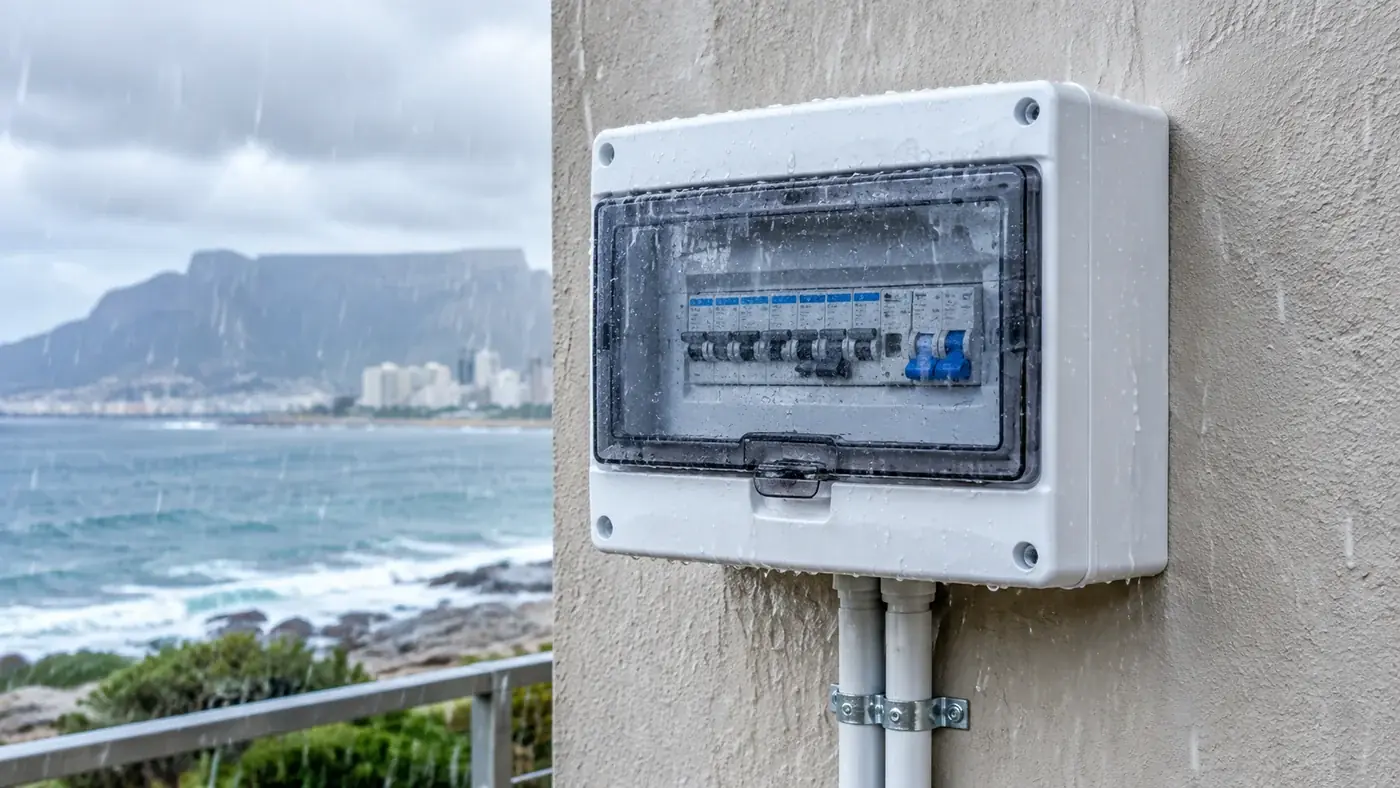
For South African conditions, three environments drive the choice of distribution board:
The IP number should be traceable to a test rather than to a catalogue claim. “Waterproof” is not a rating, and IPX4, which covers splashing water, is not the same protection as IP65. The comparison of IP65, IP66 and IP67 for distribution boxes explains what each level actually resists.
Material choice is usually argued on cost. In South Africa the code gives a cleaner criterion. Accessible parts must not reach a safe-touch temperature above 70 °C for metallic parts and 90 °C for non-metallic parts under normal operating conditions. Non-metallic enclosures are allowed to run hotter before they fail that test, which is one reason plastic distribution boards dominate domestic work.
The second criterion is location. Where equipment is mounted in a fire risk area or against flammable material, it must be of, or enclosed by, thermally non-conductive non-flammable material, or arranged so that the flammable material is not subjected to hazardous heating or so that arcs and sparks are contained.
Set against those two rules, the trade-off looks like this:
| Material | Where it fits | Where it fails |
|---|---|---|
| ABS | Indoor domestic and light commercial distribution boards, protected positions | UV exposure, sustained heat, outdoor mounting |
| Polycarbonate | Outdoor and semi-exposed boards, industrial positions, higher impact and UV resistance | Solvent contact, higher cost per way |
| Sheet steel | Plant rooms, workshops, larger three-phase boards | Coastal corrosion unless properly pretreated; needs reliable earthing of the enclosure |
A steel enclosure is not automatically the “industrial” answer. On the coast, an untreated steel box is a maintenance liability that a polycarbonate board would have avoided. The comparison of PVC, polycarbonate and ABS enclosures goes through the failure modes in more detail.
Work through these in order. Fixing the enclosure specification first avoids reworking it after the installer’s load schedule arrives.
| Item | What to fix | Why it matters here |
|---|---|---|
| System | 230 V single-phase or 400 V three-phase, 50 Hz | Determines pole count of the main device and bar sizing |
| Ways | Final circuits plus 20–25% spare, plus changeover and SPD space in the distribution board | Load shedding conversions add devices after handover |
| Earth leakage | Space and neutral capacity for devices at or below 30 mA | Fixed limit in the code; devices need rail and neutral terminals |
| Alternative supply | Changeover with interlock, essential-loads section, notice space | Added by the 2020 edition; cannot be retrofitted into a full board |
| Enclosure | Material, IP rating, door type, lock, gland plate provision | IP rating may not be reduced later |
| Bars | Neutral and earth bar ratings matched to ways | Undersized bars get overfilled, not replaced |
| Labelling | Circuit identification and a schematic holder inside the door | Both are inspection items |
| Components | LOA number per device, certificate holder confirmed | Buyer’s problem, not the supplier’s, at clearance |
If the way count is still open, the guidance on electrical distribution box sizes gives a more detailed method than the percentage rule above.
The compulsory specifications name categories such as circuit-breakers (VC 8036), earth leakage protection units (VC 8035), manually operated switches for fixed installations (VC 8003) and plugs and socket outlets (VC 8008). An empty enclosure is not named by these. Whether a specific enclosure falls under a compulsory specification depends on how it is classified for import, so confirm it against the HS code with the NRCS or your clearing agent rather than relying on a supplier’s assurance.
The installation. A CoC is issued by a registered person after testing the installation against SANS 10142-1, and it is what a property transfer or an insurer will ask for. It is not a product certificate and it does not transfer to another property or another board.
The standard sets the rated earth leakage tripping current at not more than 30 mA, and where a socket outlet circuit is protected at a higher tripping current, a warning label stating that current must be fitted. A higher setting with no label is not a compliant arrangement, and on socket circuits the 30 mA threshold is the practical answer in any case.
An interlocked changeover device, a power-on indicator and notice on each board the alternative supply feeds, a notice that the standby main switch must be opened in an emergency, and earth leakage protection at or below 30 mA on standby socket circuits. Physically that is rail width, a neutral path, and a section of the board reserved for the essential loads.
It permits one rather than requiring it, and directs that selection, connection and application follow the surge protection application standard, with a risk assessment as the basis for the decision. That said, in Highveld thunderstorm areas an SPD is a cheap addition at the build stage and an awkward one afterwards. The difference between a voltage protector and a surge protector is worth understanding before you decide which one the site needs.
Only through an interlocked changeover device, and not at all if the generator is a 230 V unit with a centre-tapped earthed winding — that type must not be connected to the fixed installation and is limited to feeding appliances directly as a free-standing unit.
Fix the distribution board specification before you fix the price. Establish the system voltage and pole count, count the final circuits and add spare ways for the changeover and surge protection that load shedding conversions will eventually need, then choose material and IP rating against the actual mounting position rather than a default. Get those settled and the compliance conversation becomes short, because the enclosure is no longer the variable.
If you are specifying boards for a South African project and want the way count, changeover space and IP rating checked against your load schedule before production, send the details and we will come back with a matched configuration. The plastic distribution box range covers the ABS and polycarbonate options discussed above.