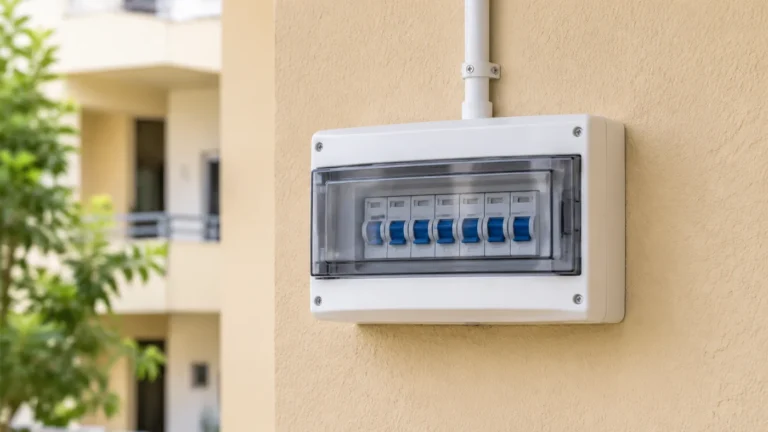
Distribution Boards for the UAE: Heat, IP Rating and G-Mark
Published: Author: Rachel
A distribution board specified for a European plant room is usually designed around an ambient of 25 to 35 °C. Put the same distribution board in a Dubai utility room, on a shaded wall in Jebel Ali, or inside a Riyadh substation compound, and the ambient is 45 to 50 °C before the sun touches it and before anything inside the enclosure starts generating heat. Nothing about the enclosure looks wrong. It is the same IP rating, the same material, the same dimensions. It is simply being operated outside the conditions it was specified for, and the first symptom is a breaker that trips below its nameplate current.
This guide works through what governs a distribution board in the UAE and across the Gulf: which approvals actually apply to an empty enclosure, why the thermal design condition is the real constraint, and why the GCC — one certification market — contains two different electrical frequencies.
What governs a distribution board in the UAE
Three schemes exist and they answer different questions. Confusing them is the most common mistake in Gulf compliance paperwork.
ECAS — the Emirates Conformity Assessment Scheme, run by the Ministry of Industry and Advanced Technology. It applies to products that appear in the ministry’s list of regulated products. A certificate is issued against the applicable UAE standard.
G-Mark — the Gulf mark issued under a GCC technical regulation, through a body notified by the Gulf Standardization Organization. It applies to product categories named in a Gulf technical regulation, and the certificate is registered in the Gulf tracking system with a symbol and QR code.
Saudi SABER — a separate national platform, covered further below, because Saudi Arabia is where most Gulf shipments actually stall.
Here is the part that matters for this product category. The Gulf technical regulation for low-voltage electrical equipment, BD-142004-01, does not cover enclosures. It names thirteen categories: domestic fans, refrigerators and freezers, centrifugal clothes dryers and washing machines, food grinders and mixers and juice extractors, toasters, electro-thermic hair-dressing apparatus and hand dryers, domestic electric heating apparatus, microwave ovens, other ovens and cookers and cooking plates and grills, electric water heaters and immersion heaters, electric smoothing irons, plugs and socket outlets and adaptors and cord extension sets and chargers, and air conditioners.
An empty distribution board enclosure is not on that list, and it is not a “low-voltage electrical appliance” in the sense the regulation uses. In the UAE that means an ECAS certificate for this product category is equally unlikely to be the document that applies, and the same HS-code check settles both questions. So a supplier who tells you the enclosure carries a G-Mark is either describing a different product or describing something that does not exist. What a G-Mark does tell you is that the devices inside — if they are plugs, sockets or adaptors — were assessed.
Two other markets take opposite routes and are worth comparing. India names the enclosure directly in a compulsory order, which makes the licence the gate rather than the test report. South Africa does not name it, and moves the requirement onto the components inside and onto the installation certificate instead — the guide to distribution boards for South Africa sets out how that works.
For the enclosure itself, the correct evidence is a different document entirely: a type test report to IEC 62208, the standard for empty enclosures for low-voltage switchgear and controlgear assemblies. That standard is written for exactly this supply situation — the enclosure manufacturer supplies an empty box, before the panel builder installs anything in it — and it is what a serious buyer will ask for, whether or not a national scheme compels it.
Whether a given distribution board falls inside a national regulated list in the UAE or elsewhere depends on how it is classified for import, which is a tariff question. Confirm it against the HS code with the ministry or your importer before you assume either outcome. What you should not do is assume that the absence of a mandatory mark means the absence of a technical requirement.
If the component set inside the board is still unfamiliar, the overview of distribution box types and functions covers what a populated board contains before the thermal questions start.
50 °C is the design condition, not the exception
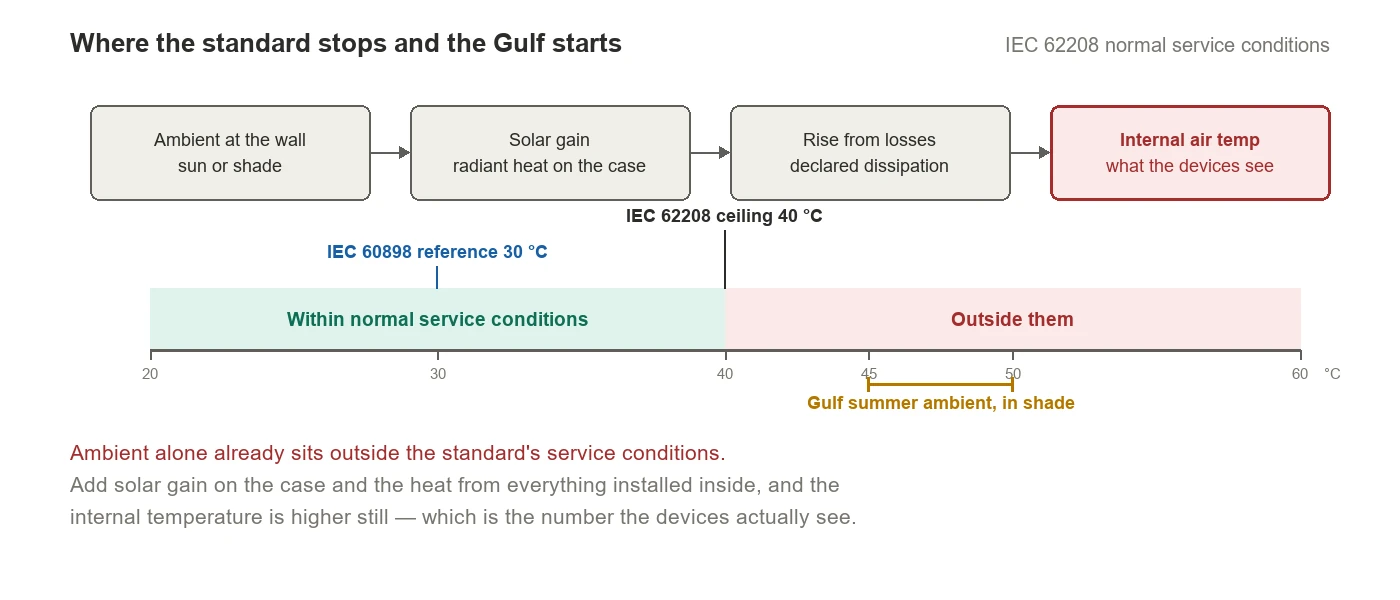
IEC 62208 enclosures are specified for normal service conditions that top out at +40 °C ambient, with type tests carried out at ambient between 10 °C and 40 °C. Read that as the ceiling of the standard, not a comfortable design point. In the Gulf, summer daytime ambient in the shade reaches the mid-to-high 40s and passes 50 °C in exposed locations, and an enclosure in direct sun runs hotter than the air around it because of radiant gain.
On top of ambient, the enclosure has to dissipate the losses of everything installed inside it. That is why the standard requires the manufacturer to declare a thermal power dissipation capability — the heat the enclosure can shed for a given internal temperature rise, which depends on the material, the mounting method, whether it is ventilated, and how many horizontal partitions it has. The relationship is straightforward and unforgiving:
Installed losses, plus ambient, plus radiant gain, must stay below the temperature the devices inside are rated for. The enclosure’s declared dissipation capability is what determines whether that holds.
Ambient, solar gain and the losses from everything inside add up to the temperature the devices actually see — which is what the derating table is quoted against.
This is where Gulf projects go wrong in a way that no datasheet catches. The switching device inside the box is calibrated at a reference ambient — 30 °C for a miniature circuit breaker under IEC 60898, typically 40 °C for a moulded case device. A distribution board whose internal temperature reaches 55 °C is not operating at 55/30 of its rating, but it is operating meaningfully below its nominal current, and the manufacturer’s derating table is the only number worth using.
Two practical consequences follow. First, when a distribution board is specified in the Gulf, the way count and the main device rating should be based on the derated capacity at the expected internal temperature, not the catalogue rating. Second, the thermal question has to be answered before the material and IP rating are chosen, because the answer sometimes changes them.
What a breaker actually carries at Gulf temperatures
It is worth being concrete about the mechanism, because it explains why undersizing is so common and so invisible.
Thermal-magnetic devices trip on a bimetal strip heated by the current passing through it. The bimetal responds to the temperature difference between itself and its surroundings. When the surroundings are already hot, less current is needed to reach the trip threshold. Nothing has failed; the device is behaving exactly as designed, just not as assumed.
The same logic applies to the equipment being protected. Cable current-carrying capacity is also quoted for a reference ambient, and in a hot enclosure the cable carries less. A design that was coordinated at 30 °C may be uncoordinated at 50 °C, because the breaker derates and the cable derates by different amounts.
The practical instruction for a distribution board is narrow and worth stating plainly: ask for the derating table at the actual internal temperature, for every device in the board. A supplier who can only quote nominal ratings has not designed for this market. If the distribution board is being supplied empty, the obligation passes to the panel builder, and the enclosure’s job is to make the thermal calculation possible — which means declaring its dissipation capability rather than leaving it blank.
The GCC is one market with two frequencies
This catches people who treat the Gulf as a single specification. Saudi Arabia operates its grid at 60 Hz. The other five member states — the UAE, Qatar, Kuwait, Bahrain and Oman — operate at 50 Hz. The two systems are physically joined by a back-to-back high-voltage direct current converter station at Al-Fadhili, which exists precisely because the frequencies cannot be synchronised.
So a distribution board built to one Gulf specification is not automatically correct for both halves of the market.
Market
Voltage
Frequency
Note
UAE, Qatar, Kuwait, Bahrain, Oman
230/400 V
50 Hz
G-Mark category applies to appliances, not enclosures
Saudi Arabia
230/400 V
60 Hz
Transitioning from a legacy 127/220 V 60 Hz system
Saudi’s transition is worth knowing because it explains equipment found on older sites. Under Council of Ministers Resolution No. 324 of 2010, distribution voltage for residential and commercial areas is being changed from 127/220 V to the international 230/400 V, in a staged programme with a preparatory period and an implementation period running to about 2026. Import of 127 V appliances and power tools has not been permitted since 2012. Legacy 127/220 V areas still exist, and a distribution board specified for one of them is a genuinely different product.
For an empty enclosure, frequency is irrelevant — the box does not care. For a populated board it is not. Any device with a coil is frequency-specific: a contactor, a shunt trip, an undervoltage release, a timer. An electronic trip unit is calibrated for one frequency. Send a 50 Hz-populated distribution board into a 60 Hz Saudi project, or the reverse, and the protection may hold but the control will not behave.
At minimum, get the frequency onto the specification and onto the nameplate, and stop treating “GCC” as one line item.
Saudi Arabia: PCoC, SCoC and where shipments actually stall
Saudi Arabia runs its own national system through the SABER platform, and it sits on top of anything Gulf-wide rather than replacing it.
PCoC — Product Certificate of Conformity, issued for a regulated product through a SASO-approved body, valid for one year, and it is the product’s route to the market.
SCoC — Shipment Certificate of Conformity, required for each consignment, linked to a valid PCoC, and it is what actually clears customs.
SASO IECEE recognition — for electrical products, SASO recognises an IECEE CB certificate through its own recognition certificate. A CB report that does not address Saudi national differences is not the same thing as one that does.
Three operational points decide whether a shipment lands or sits.
The SABER account belongs to the Saudi importer. A foreign manufacturer cannot open it or apply in its own name. Your documents go to the importer, and the importer applies. Any supplier claiming to hold a Saudi PCoC for a product you are buying should be able to name the certificate holder and the covered models.
The SCoC has to be in place before arrival. It is not a document you produce at the port. Since 2025 the undertaking letter route is no longer accepted for clearance, so the older habit of shipping first and sorting paperwork on arrival now produces demurrage instead of a delay.
Arabic labelling is a technical requirement, not a nicety. Manuals, warnings and product labels have to carry Arabic alongside English. This is the item that most often turns a compliant product into a non-compliant shipment at the last minute, because it is handled by whoever does the artwork rather than by whoever handles compliance.
IP rating for dust, sand and salt — and the trap in sealing it
The Gulf gives you two environmental problems that push in opposite directions, plus a third on the coast.
Wind-blown sand and dust — fine, abrasive, and it arrives horizontally. The first digit of the IP code is the one that matters here, and a cabinet that is dust-tight by test is not the same as a cabinet with a gasketed door that was never tested.
Heat — which is why ventilated enclosures are attractive, and why ventilated enclosures fail the dust requirement. You cannot solve both with a louvre.
Salt on the coast — Jebel Ali and the northern emirates, Doha, Kuwait City, Jubail. Terminal screws, busbars and fixing hardware corrode, and no IP number describes that. Stainless fixings and a proper coating system are the answer, not a higher second digit.
There is a further trap worth naming. Sealing an enclosure to keep sand out reduces its ability to shed heat, which is the mechanism described above. A fully sealed distribution board in direct Gulf sun, with a full complement of breakers inside, is the worst of both. Where the site demands both dust exclusion and real thermal headroom, the answer is usually shading or relocating the distribution board rather than choosing a higher IP number and hoping.
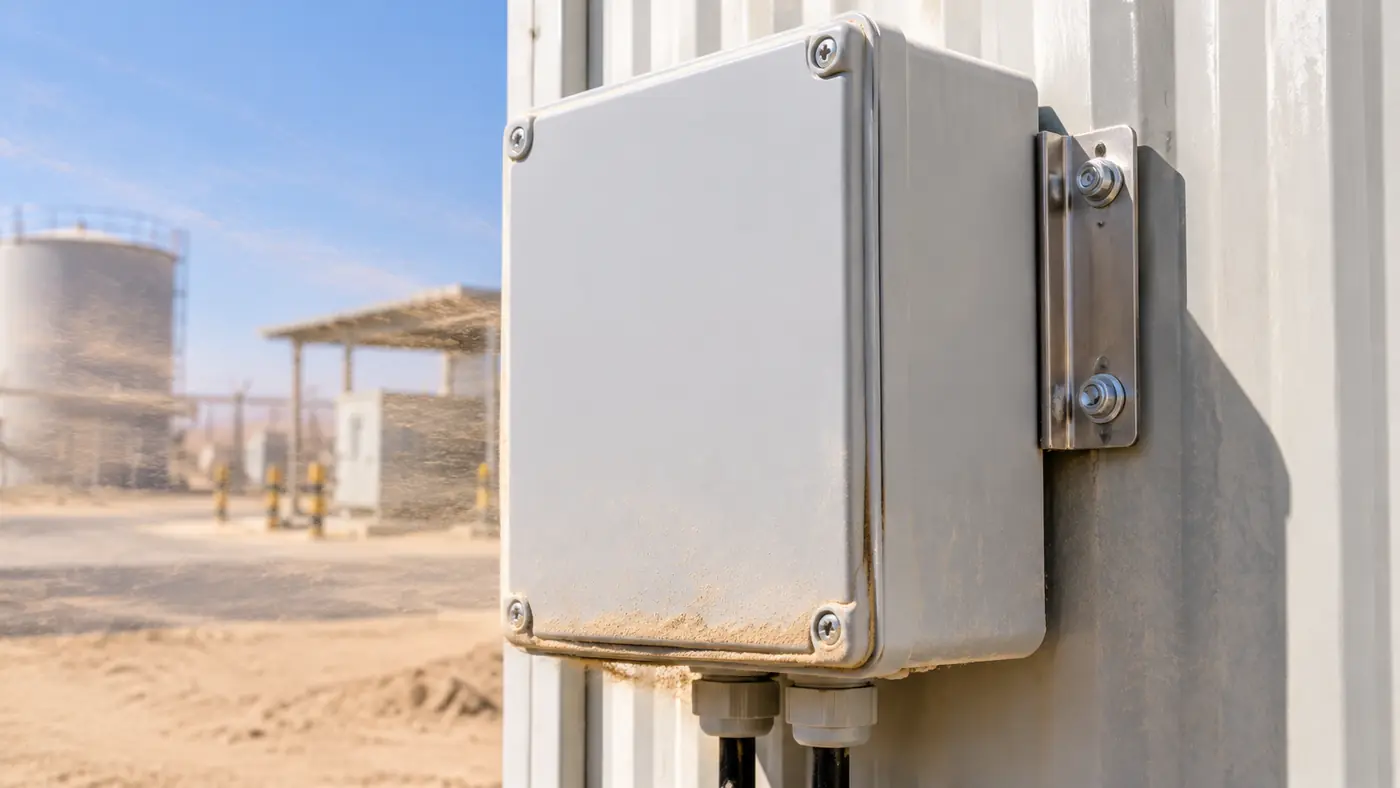
Sand settles on the lower edge and into the gasket. Sealing it out reduces the enclosure’s ability to shed heat, which is the trade-off this climate forces.
ABS, polycarbonate or steel under Gulf UV and heat
Material selection in this region is dominated by two properties that European selection guides treat as secondary: UV stability and heat ageing.
Material
Behaviour in Gulf conditions
Where it fits
ABS
Degrades under sustained UV; softening and colour change appear sooner at high ambient
Indoor, shaded, air-conditioned plant rooms
Polycarbonate
UV-stabilised grades hold up outdoors; good impact resistance; still accumulates heat
Outdoor and semi-exposed boards, most coastal work
Sheet steel
Physically robust and the best heat spreader of the three, but corrodes fast on the coast without proper pretreatment
Industrial and substation boards, provided the coating system is real
Two notes that are specific to a distribution board in this climate. First, a dark-coloured enclosure absorbs more solar gain than a light one, and colour is usually chosen for aesthetics or corporate identity rather than thermal reasons — worth raising once. Second, powder coating is not automatically a corrosion system; on the coast, pretreatment and coating thickness decide the outcome, and a thin decorative coat fails within a few years.
Pretreatment and coating system for steel, stainless fixings
Coastal salt attacks hardware first
Labelling
Arabic and English for Saudi; consistent rated voltage
Arabic labelling is a clearance requirement
Approvals
HS code checked against the national regulated list
An empty enclosure is not in the G-Mark categories
If the way count is still open, the guidance on electrical distribution box sizes covers the method; the extra step here is that the derating has to be applied before the count is fixed, not after.
Frequently asked questions
Does a distribution board need a G-Mark in the UAE?
The Gulf technical regulation for low-voltage electrical equipment names thirteen appliance categories, plugs and socket outlets, and air conditioners. An empty enclosure is not among them, so a G-Mark is not the applicable document for an enclosure. What applies depends on whether the product appears in the national regulated product list, which is a question of HS classification.
What standard covers an empty distribution board enclosure?
IEC 62208, empty enclosures for low-voltage switchgear and controlgear assemblies. It covers enclosures supplied before components are installed, classified by material, mounting method, indoor or outdoor use, IP code and impact code, and it requires the manufacturer to declare the thermal power dissipation capability.
Why does a breaker trip below its rated current in the Gulf?
Because the thermal element responds to the difference between its own temperature and its surroundings. A device calibrated at 30 °C reference ambient, installed in an enclosure whose internal temperature reaches 50 °C or more, trips at a lower current than the nameplate value. The manufacturer’s derating table gives the actual figure.
Is Saudi Arabia 50 Hz or 60 Hz?
60 Hz. Saudi Arabia’s grid operates at 60 Hz while the other five GCC states operate at 50 Hz, and the two are joined through a back-to-back HVDC converter station. Saudi distribution voltage is being migrated from a legacy 127/220 V system to 230/400 V under a programme that began in 2010.
Can one distribution board specification cover the whole GCC?
For the enclosure, largely yes — the box does not care about frequency. For a populated board, no. Coil-operated devices and electronic trip units are frequency-specific, and the national approval route differs between Saudi Arabia and the other member states.
Does IP65 make a distribution board suitable for outdoor Gulf installation?
It makes it resistant to dust and water jets. It says nothing about UV ageing, corrosion, or the internal temperature rise, and a well-sealed enclosure sheds heat less readily than a ventilated one. Outdoor suitability is a combination of IP rating, material, coating and thermal design.
Where to start
Start with the number nobody puts on a quotation: the design ambient at the mounting position, in sun or shade. On UAE projects this is the difference between a shaded plant room at 38 °C and an exposed wall in August. From that, the enclosure’s declared dissipation capability and the installed losses give the internal temperature, and the internal temperature gives the derated device ratings. Only then does the way count mean anything. After that, pin the market down to a country rather than a region, because frequency and national approval differ, and confirm the HS classification against the regulated list instead of assuming a mark applies.
If you are specifying distribution boards for a Gulf project and want the ambient, thermal budget, IP rating and material checked against the mounting position before production, send the details and we will come back with a matched configuration. The plastic distribution box range covers the polycarbonate options discussed above.
A practical guide to distribution boards in South Africa: 30 mA earth leakage, interlocked changeover for load shedding, IP rating for coastal salt and Highveld dust, and the NRCS LOA rules.
A practical guide to distribution boards in the Philippines: 230 V three-wire and 460/265 V services, neutral and ground bar separation, dedicated electrical space, and BPS approvals.
What IS 14772:2020 covers for Indian distribution boxes, how mounting type and IP rating define the variety, and how BIS licence scope works under the QCO.