How to Protect a Water Pump Motor from Overload
Protect a water pump motor from overload: why pump motors overheat, how to select and set an MPCB, and which pump-specific protections to add.
Read More
A direct-on-line (DOL) starter connects a motor to the supply at full line voltage. It is a common arrangement for pumps, fans, conveyors, compressors, and industrial machinery when the motor and supply can accommodate the starting current.
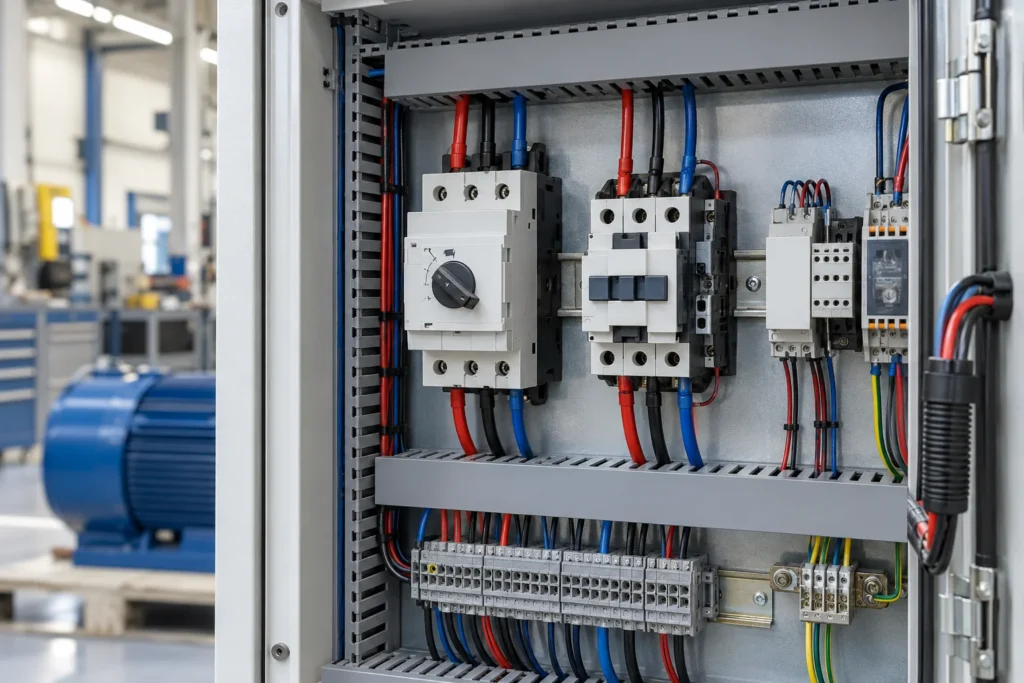
In a typical three-phase assembly, a motor protection circuit breaker (MPCB) provides motor-specific overload and short-circuit protection, while a contactor switches the motor in response to a push button, controller, or other control signal.
If you are specifying MPCB and contactor wiring for a new control panel, start with the motor nameplate and the manufacturer’s component data. This guide explains the roles of the devices, the basic power and control circuit arrangement, and the checks to make before ordering a starter combination.
The MPCB is selected for an individual motor circuit. Depending on its design, it may provide adjustable thermal overload protection and magnetic short-circuit protection. Some models also have phase-loss sensitivity. Check the exact model’s data sheet before claiming or relying on a particular function.
The contactor opens and closes the motor power circuit when its coil is energized or de-energized. This makes it suitable for normal electrical start/stop control, including operation from a push-button station or an automation system. An auxiliary contact can support a holding circuit or status indication, if the selected contactor provides the required contact arrangement.
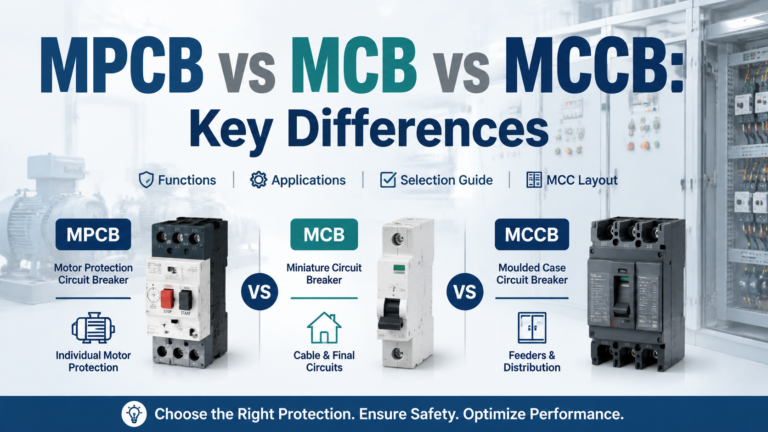
The two devices therefore serve different roles: the MPCB protects the motor branch, while the contactor handles commanded switching. Depending on the application, other components may still be needed, such as a control-circuit protective device, emergency-stop arrangement, undervoltage release, or additional process protection.
In a common three-phase, non-reversing DOL starter, the power path runs from the three-phase supply through the MPCB, then through the contactor’s main poles to the motor. A separate control circuit energizes the contactor coil through the chosen start/stop and safety controls. When the contactor closes, the motor receives full line voltage. When the contactor opens, the motor is disconnected from its normal power path.
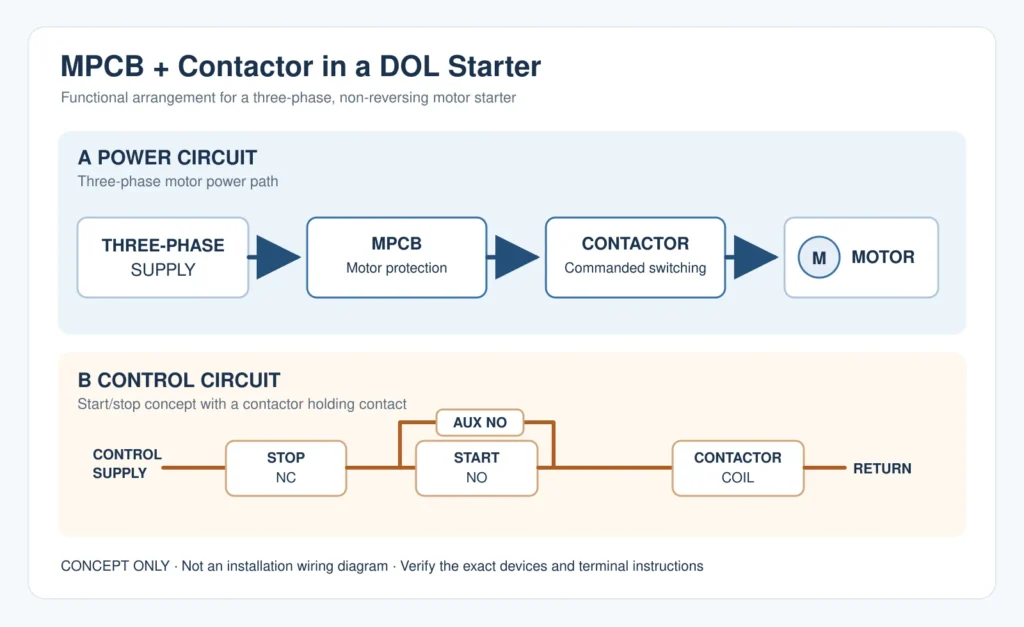
Do not copy a terminal layout from another brand into the final drawing. In particular, confirm the coil voltage and frequency, auxiliary-contact type, device terminal markings, control-power source, and the intended stop and reset behavior for the actual assembly.
An MPCB can provide manual operation for suitable applications, but an operating handle does not replace an electrically controlled contactor when the equipment needs remote start/stop or automatic commands. The contactor is chosen for the motor’s voltage, current, and switching duty; the MPCB is chosen to protect the motor branch and suit the available fault level. A proposed combination must be checked as a system rather than selected from current ratings alone.
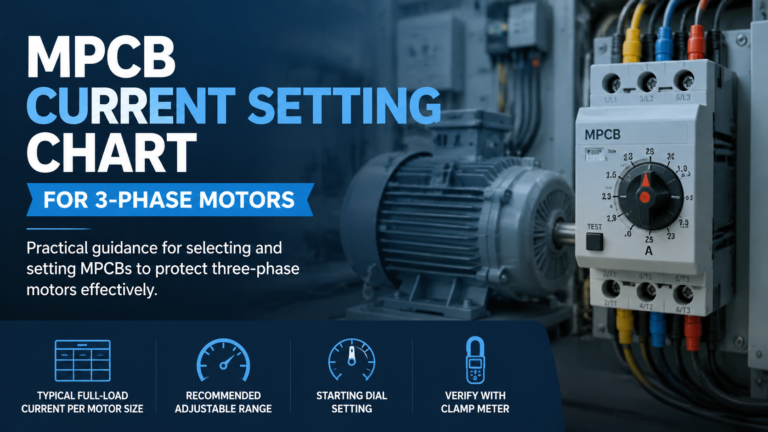
Record the motor’s rated voltage, full-load current, power, frequency, and phase configuration. The motor’s rated current is the starting point for choosing an MPCB adjustment range. A kW or HP figure can help narrow the options, but motors with the same power can have different rated currents.
If you need a deeper selection walkthrough, read ZKELE’s guide to selecting an MPCB for a three-phase motor. Treat any example setting in a general guide as illustrative: the final dial position must follow the specific MPCB instructions, the motor data, and the rules that apply to the installation.
Choose a model whose adjustable overload range includes the motor’s nameplate current. Then check the rated operational voltage, poles, short-circuit characteristics, and required protective functions against the product documentation. Do not assume that every MPCB offers an adjustable magnetic threshold, a selectable trip class, or the same phase-loss behavior.
For example, ZKELE lists a detailed range of GV2-M manual starter and protector models. Use the individual model row and its confirmed documentation when comparing settings and ratings, rather than treating one specification as valid across the whole family.
Check the contactor’s motor-duty rating at the operating voltage, its intended switching frequency, and its coil supply. Also confirm whether the control design needs a normally open auxiliary contact for a holding circuit, a normally closed contact for indication or interlocking, or both. Mechanical fit and approved connection accessories matter if a compact MPCB–contactor assembly is required.
The available prospective short-circuit current at the installation point must be considered when selecting protective equipment. If the project specifies a particular short-circuit coordination level for the motor starter, request manufacturer-tested coordination data for the exact MPCB and contactor combination. A breaking-capacity value printed for an individual component does not, by itself, establish the rating or post-fault behavior of an assembled starter.
Confirm the expected start frequency, motor starting time, ambient conditions, mounting space, and enclosure requirements. A DOL starter applies full line voltage to the motor at startup; where starting current or mechanical stress is a concern, the project may call for a different starting method. Pumps may also need process-specific protection, such as dry-run detection, beyond electrical motor protection. For a pump example, see how to protect a water pump motor from overload.
| Mistake | Why it matters | Better approach |
|---|---|---|
| Choosing an MPCB from motor power alone | Rated motor current varies by design and voltage. | Start with the motor nameplate current and confirm the model’s adjustable range. |
| Assuming the MPCB replaces the contactor | Manual operation does not provide the required remote or automatic switching function. | Specify a suitably rated contactor when the control scheme requires it. |
| Ignoring coil voltage | The contactor coil must match the designed control supply. | Confirm the actual coil voltage, frequency, and control circuit before ordering. |
| Mixing unverified component combinations | Individual ratings do not prove starter coordination. | Request combination data for the selected MPCB, contactor, and accessories. |
| Treating a generic diagram as installation instructions | Terminals and control details vary between models. | Use the exact product manuals and an engineer-approved final schematic. |
To request an MPCB and contactor combination, send the motor nameplate photo or at least its voltage, full-load current, kW/HP, and frequency. Add the control-coil supply, starting method, expected starts per hour, installation country, enclosure requirements, and any required short-circuit or coordination rating. If you already have a panel drawing, send it with the inquiry so the supplier can confirm the accessories and physical fit.
ZKELE offers motor protection circuit breakers including GV2-M and GV3-M product pages. The appropriate device and any compatible contactor should be confirmed for the actual motor and project requirements. Contact ZKELE with your motor data to request product information and a quotation.
It can serve as a manual motor controller where the device is rated and the application allows manual operation. Add a suitable contactor when the system requires electrical start/stop commands or automation. Confirm the final configuration with the product documentation and the applicable installation requirements.
A thermal-magnetic MPCB can provide motor overload protection when correctly selected and set. Another starter design may use separate short-circuit protection, a contactor, and an overload relay. Select the arrangement based on the motor, control needs, applicable requirements, and verified combination data.
Do not assume that current ratings alone establish compatibility. Check motor-duty ratings, coil and auxiliary-contact needs, physical connection, and any required short-circuit coordination data for the exact devices.
Use the motor nameplate current as the starting input, then follow the specific device instructions and the requirements that apply to the installation. Avoid applying a fixed percentage from a generic article to every motor or MPCB.
No. A DOL starter is appropriate only where the motor, supply, load, and starting conditions allow direct full-voltage starting. Larger or demanding loads may need another starting method and a different protection arrangement.