Distribution Boards for the UAE: Heat, IP Rating and G-Mark
A practical guide to distribution boards in the UAE and Gulf: the 40 °C service condition, device derating, IP rating for sand and salt, and where G-Mark and SABER apply.
Read More
Nigeria runs 230 V single-phase and 415 V three-phase at 50 Hz, and a large share of installations do not rely on the grid alone. A generator, a changeover switch, or a hybrid solar inverter usually shares the same board. That changes what the distribution box has to do: it needs more usable space, more ways than the load schedule first suggests, protection that survives coastal humidity or harmattan dust, and documentation that clears customs without a delay at Apapa or Tin Can Island.
Five factors decide whether a distribution box ordered for Nigeria will actually work on site:
This guide works through each one in the order a distribution box specification is actually built, then covers what the factory has to supply for SONCAP clearance.
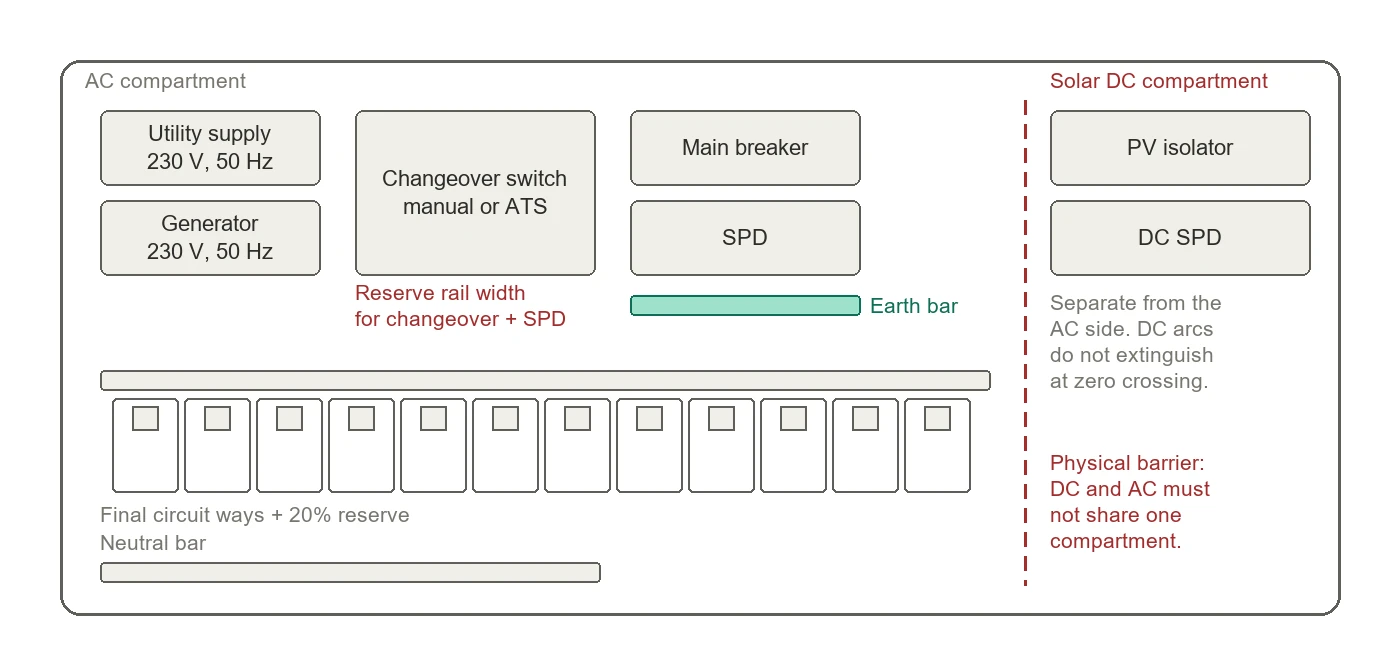
On a grid-only installation, the distribution box holds the main breaker and the final circuit breakers. In Nigeria, the same box often also carries a manual changeover switch or an automatic transfer switch (ATS), a surge protective device (SPD), and sometimes the AC side of a solar inverter. Each of those consumes DIN rail width and, more importantly, changes the internal layout.
Changeover switches cost width, not just a slot. A manual changeover for a 100 A single-phase supply is physically deeper than an MCB, and the incoming cables from both the utility and the generator have to bend inside the enclosure. If the distribution box is sized on breaker count alone, the door will not close cleanly and the cable bending radius will be violated.
Surge protection needs a short, direct path to earth. An SPD mounted at the far end of a long internal run of thin cable loses much of its effectiveness. Reserve rail space next to the main incoming terminals so the device can sit close to the supply and to the earth bar. If the site has a history of equipment loss during grid switching, it is worth separating what a voltage protector does from what a surge protector does before specifying — the two are often confused, as explained in voltage protector vs surge protector.
Solar introduces a DC side that should not share the AC compartment. DC arcs do not self-extinguish the way AC arcs do at zero crossing, and a PV string can sit at open-circuit voltage whenever there is light. If a hybrid inverter feeds the board, plan a separate DC enclosure or at minimum a physically partitioned compartment with its own DC-rated SPD. Do not assume an AC SPD covers the PV side.
Where the installation is temporary or site-based rather than fixed, the layout constraints differ again; the guide to electrical distro boxes for temporary power covers that case.
The most common specification error is counting only today’s circuits. In Nigeria, a board is usually installed once and then extended, and retrofitting means replace, not add. The practical rule is to count final circuits and then add 20–30% spare ways.
| Application | Typical supply | Starting point for ways | Notes |
|---|---|---|---|
| Bungalow or single flat | 230 V single-phase | 8–12 | Add ways if a generator changeover is planned |
| Duplex or multi-floor home | 230 V single-phase | 12–18 | Separate ways per floor simplify fault finding |
| Shop, office, small clinic | 230 V single-phase | 12–18 | Reserve space for an SPD at the incoming end |
| Small plant or workshop | 415 V three-phase | 18–24 | Changeover often in a separate panel |
Treat these figures as starting points, not a code requirement. The correct number comes from the load schedule and the installer’s circuit design. On three-phase boards, confirm whether the way count is quoted per phase or total, because suppliers quote it both ways and the difference is a factor of three.
Nigeria has two quite different enclosure problems, and a single default IP rating serves neither well.
Coastal and southern installations — Lagos, Port Harcourt, Warri, Calabar — combine high humidity with salt-laden air. Salt deposits on metal parts and on terminal screws accelerate corrosion, and condensation inside a sealed box is a real risk when day and night temperatures swing. For a distribution box mounted outdoors and exposed, IP65 is a sensible floor and IP66 is worth specifying where driving rain is likely. Metal enclosures in these locations need proper pretreatment and a coating system, not just paint.
Northern installations — Kano, Kaduna, Maiduguri — are dominated by harmattan dust. Fine particulate passes through louvred vents and settles across breaker terminals. The failure mode is not water damage but dust bridging across insulation and around terminal screws, which shows up later as tracking or unexplained thermal trips. On these sites, dust sealing in the distribution box matters more than water resistance, and open louvre ventilation works against you.
“Waterproof” is not a rating. IPX4 means protection against splashing water; IPX5 and IPX6 mean protection against jets at increasing pressure and volume. A box described only as waterproof has no defined performance. Ask for the IP number and the standard it was tested to. The differences are set out in IP65 vs IP66 vs IP67 for distribution boxes.
Material choice for a distribution box follows directly from where it is mounted.
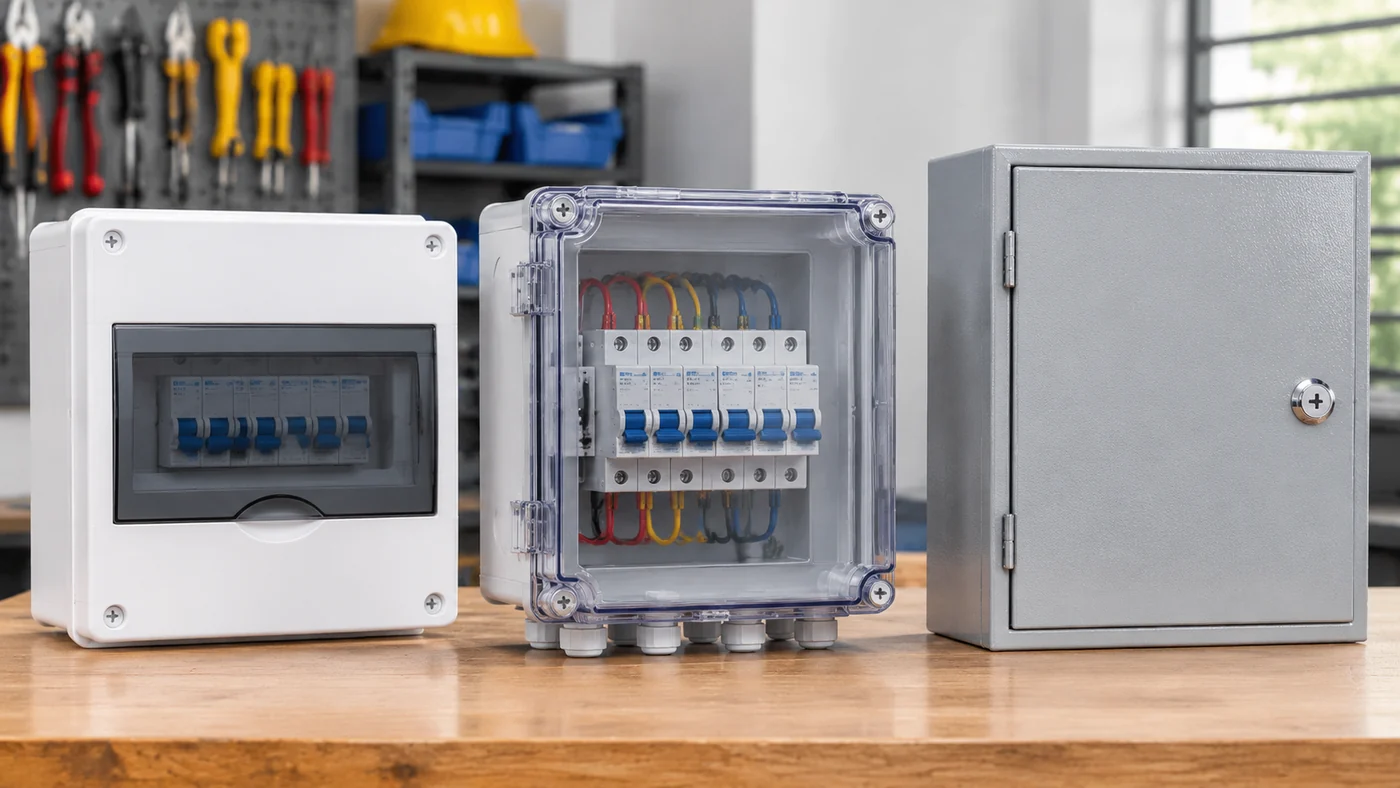
A comparison of the three materials, including where each fails, is in PVC vs polycarbonate vs ABS enclosures.
SONCAP is the Standards Organisation of Nigeria Conformity Assessment Programme. For regulated imports, including a distribution box bound for the Nigerian market, it is not optional: goods arriving without valid documentation are detained, and the certificate cannot be produced after arrival.
Distribution boxes are generally grouped with regulated electrical components rather than treated as exempt general hardware. Because the scope is set by HS code, confirm the classification with SON or an authorised conformity body before production is booked. Do not rely on a supplier’s assurance that a particular box “does not need SONCAP.”
The programme works in two stages: a Product Certificate covering the model, and a SONCAP Certificate covering each shipment. Certification bodies label the product routes slightly differently, but they fall into two practical shapes:
| Route | Validity | What it involves | When it fits |
|---|---|---|---|
| Single-shipment / unregistered | About 6 months, one shipment | Test report plus pre-shipment inspection during loading | Trial orders, one-off projects, many models at low volume |
| Registered or licensed | 1 year, reusable across shipments | Testing plus factory audit and periodic surveillance | Repeat shipments of stable models |
Split the work by who is responsible, because this is where shipments most often stall:
| The factory supplies | The importer handles |
|---|---|
| Test report from an ISO/IEC 17025 accredited laboratory | Form M through their bank or the national single window |
| ISO 9001 certificate, where the registered route is used | Shipment certificate application for each consignment |
| Technical file: drawings, ratings, nameplate and packaging artwork | PAAR and customs documentation at the Nigerian end |
| Consistency between shipped goods and the tested sample | Payment of applicable fees |
The sequencing trap. The shipment certificate is applied for per consignment and must be in place before the goods leave. Teams that plan to “sort the paperwork at the port” end up paying demurrage while the container sits. Build the certificate into the production schedule, not the shipping schedule.
Ask which standard the test report cites. For enclosures this is typically the IEC 60670 series. The report must reference the same standard your SONCAP application will cite, and it must cover the model actually shipped. A report for a similar box in a different size is not a substitute.
If you are specifying an MPCB alongside the board, note that motor protection devices are certified under a separate standard from the enclosure, and the two report sets should not be conflated.
That report-based route is not universal, and it is worth knowing before you plan a shipment into a second market. Where the licence is granted to the manufacturing location and covers only the varieties listed in its scope, the report is one input rather than the gate, and the timeline is measured in months rather than weeks. The guide to IS 14772 and the Indian BIS licence sets out how that arrangement works in practice.
| Parameter | What to confirm in writing |
|---|---|
| Rated voltage and frequency | 230 V single-phase or 415 V three-phase, 50 Hz |
| Ways and spare capacity | Total ways stated per phase or overall, plus agreed spare percentage |
| IP rating | The IP number and the standard it was tested to, not a marketing word |
| Material and finish | ABS, polycarbonate or steel grade, plus coating system for coastal sites |
| Internal layout | DIN rail length, reserved space for changeover and SPD, earth and neutral bar capacity |
| Terminal ratings | Incoming and outgoing terminal size matched to your cable schedule |
| Mounting | Surface or flush, door type, lock provision |
| Documentation | Test report standard, certificate holder, and who applies for the shipment certificate |
If you are still narrowing down capacity before this stage, the guidance on electrical distribution box sizes covers how physical space relates to way count. For the wider set of enclosure types, see electrical distribution boxes: types, components and functions.
230 V single-phase and 415 V three-phase at 50 Hz. Confirm the phase configuration of the actual supply before ordering; a three-phase board cannot be substituted for a single-phase one without rewiring.
Distribution boxes are generally treated as regulated electrical components, but the scope is determined by HS code. Confirm the classification with SON or an authorised conformity body before you book production. An empty enclosure is not automatically exempt.
Yes, provided it comes from an ISO/IEC 17025 accredited laboratory and the standard cited is acceptable to the conformity body assessing the application. Confirm acceptance before testing, not after.
The product certificate is normally driven by the exporter or factory. The per-shipment certificate requires the importer’s Form M and is applied for with the factory’s documents. Neither party can complete it alone.
No. The shipment certificate must be obtained before the consignment leaves. Goods that arrive without valid documentation are held, and storage costs accrue to the cargo.
For exposed outdoor positions, treat IP65 as a floor and IP66 as the safer specification, and pay equal attention to the coating system on metal enclosures. Indoor positions in air-conditioned space can use a lower rating, but salt air still reaches most plant rooms.
Work the specification in order: confirm the supply voltage and phase, build the way count from the load schedule and add spare capacity for changeover and surge protection, then pick the IP rating and material from the actual site rather than from a catalogue default. Only after those are settled does the SONCAP route make sense, because the certificate has to cover the model you are actually shipping.
If you are sourcing a distribution box for Nigeria and want the enclosure layout, IP rating and documentation checked against your load schedule before committing to a production run, send the details and we will come back with a matched configuration. The plastic distribution box range covers the ABS and polycarbonate enclosure options discussed above.