How to Select Motor Protection for Conveyor Systems
Published: Author: Rachel
Conveyor systems are used in manufacturing plants, warehouses, mines, packaging lines and material-handling facilities. Choosing an MPCB for conveyor motor applications requires an understanding of the machine’s operating conditions, not just the motor’s kilowatt rating. Although a conveyor may appear to be a simple motor-driven machine, its operating conditions can place demanding requirements on the motor and its electrical protection.
A conveyor may start with material already on the belt, operate for long periods, stop and restart frequently, or use several motors across one line. A jammed belt, blocked transfer point or mechanical overload can also change the motor load. For these reasons, selecting a motor protection circuit breaker (MPCB) requires an understanding of the complete application—not just the motor’s kilowatt rating.
This guide explains the key checks that conveyor OEMs, electrical panel builders, system integrators and maintenance teams should make when specifying motor protection for a conveyor drive.
What Does an MPCB Do in a Conveyor Motor Circuit?
An MPCB is a motor-circuit device that provides the switching and protection functions stated in its product documentation. Depending on the model, these commonly include an adjustable thermal overload function and magnetic short-circuit protection. The exact current range, breaking capacity, operating voltage and other functions must be verified for the selected model.
In a conveyor installation, the MPCB protects the relevant motor circuit. It does not automatically detect every mechanical fault in the conveyor, and it does not replace belt safety switches, emergency-stop circuits, speed monitoring, belt-alignment devices, pull-cord switches or blockage sensors. These devices serve different purposes and must be considered in the machine’s overall control and safety design.
Where the conveyor requires remote, interlocked or automated operation, a contactor, motor controller, soft starter or VFD may form part of the system. The MPCB must be selected as part of the complete arrangement, with the relevant manufacturer coordination information checked.
1. Understand the Conveyor Layout and Operating Duty
Before choosing a protective device, establish what the conveyor is expected to move and how it operates. A short packaging conveyor and a long inclined bulk-material conveyor may have very different starting and running conditions.
Record the following application details:
Conveyor type: belt, roller, chain, screw, slat or another mechanism
Whether the conveyor starts empty, partially loaded or fully loaded
Material type, expected throughput and normal load variation
Incline, length, belt tension and relevant mechanical characteristics
Expected starts per hour, operating hours and stop/start sequence
Whether reversing, inching or jogging operation is required
Whether the system uses one motor or multiple drive motors
The conveyor manufacturer’s mechanical design data is important. Do not assume that a motor selected for a lightly loaded horizontal conveyor will be suitable for an inclined or high-inertia application with the same rated power.
2. Assess Starting Load, Inertia and Acceleration Time
Starting conditions are among the most important factors in conveyor motor protection. A loaded belt, high-inertia drive or mechanical system with significant friction may require a longer acceleration time or a different starting arrangement.
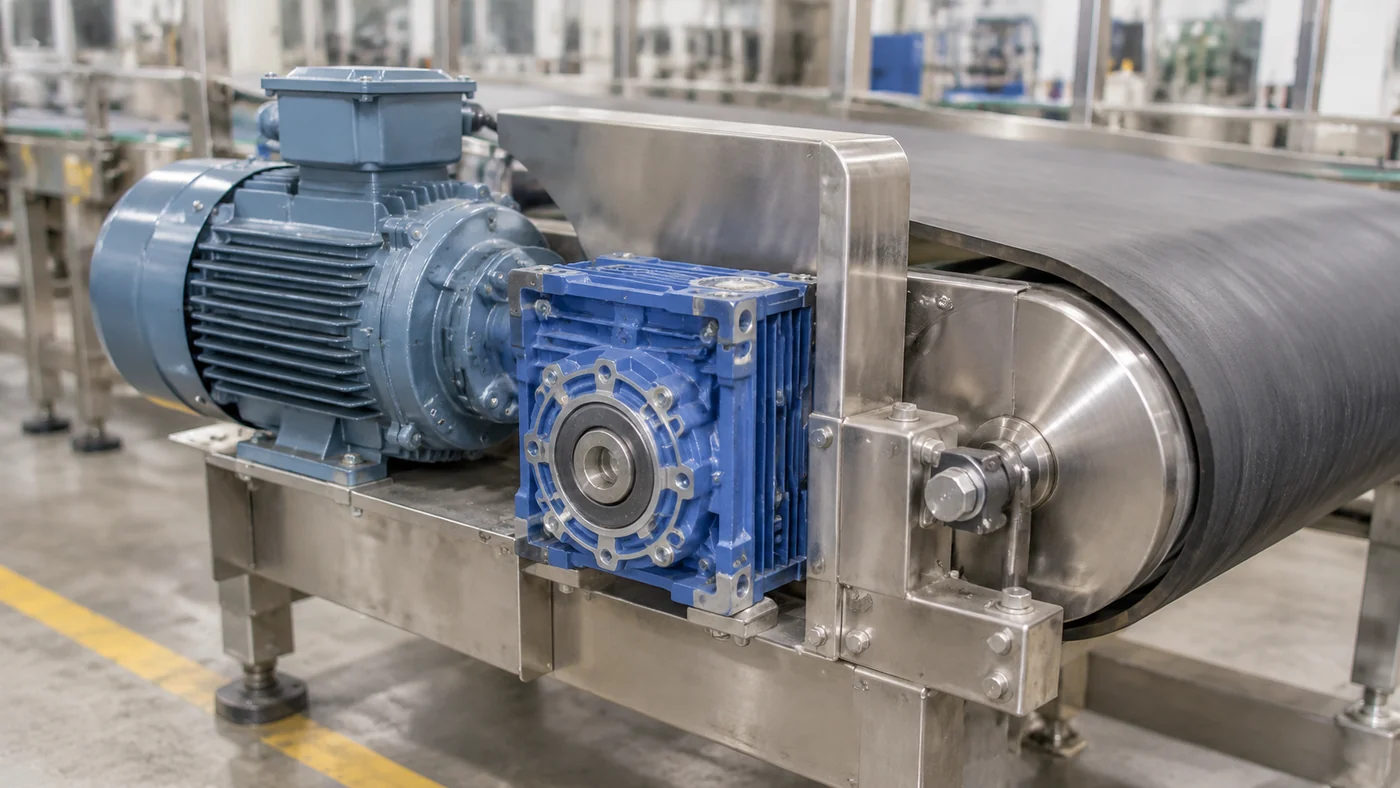
A conveyor drive station: motor, gearbox and drive pulley. A protection review has to account for the mechanical duty behind these parts, not only the motor current.
Confirm whether the conveyor is designed to start under load. If it is, obtain the motor starting data and the conveyor or drive manufacturer’s requirements. If the system uses a controlled start sequence, confirm how the control logic handles downstream and upstream conveyors, interlocks and material flow.
The selected protection device must be appropriate for the motor’s starting current and duration while still providing the required protection. Do not increase an overload setting simply to prevent trips during a difficult start. Repeated trips may indicate excessive load, a mechanical problem, incorrect starting conditions, unsuitable device selection or a fault that needs investigation.
3. Use the Motor Nameplate to Confirm the Required Current Range
The motor nameplate is the primary reference for selecting the overload adjustment range. Record the rated current for the actual supply voltage and connection. Do not select a protective device solely from motor power in kW or horsepower.
Collect at least the following motor information:
Rated voltage and connection arrangement
Rated full-load current for the intended supply
Number of phases and supply frequency
Rated power and speed
Duty rating and service-factor details, if provided
Motor starting characteristics or manufacturer data, where available
Select an MPCB whose documented adjustable range includes the required motor setting. Then set it according to the motor and device manufacturers’ instructions and applicable electrical codes. There is no single current-setting multiplier that should be applied to every conveyor motor.
4. Consider Belt Jams and Mechanical Overload Conditions
A conveyor jam can increase the mechanical load on the drive. If the motor current rises sufficiently, the motor’s overload protection may eventually operate. However, not every mechanical jam produces the same current response, and the response depends on the motor, drive, transmission, load and protection settings.
An MPCB should therefore not be treated as a complete jam-detection system. A conveyor may also require devices such as zero-speed switches, belt-slip monitors, belt-misalignment switches, blocked-chute sensors, torque monitoring or other process interlocks. The correct combination depends on the conveyor design and the risk assessment.
When specifying protection, identify which faults are expected to be detected by motor current protection and which require separate mechanical or process sensors. Make sure the control system responds safely when any protective device operates. For a comparison of the protection device types used alongside an MPCB, see motor overload protection devices.
5. Check the Starting Method: DOL, Soft Starter or VFD
The conveyor’s starting method affects current, acceleration and the placement of protective devices. The circuit design must be checked rather than assuming that one MPCB arrangement suits every starter type.
Direct-on-line (DOL) starting
For DOL starting, assess the motor’s starting current, acceleration time and the mechanical load at start-up. If a contactor is used, verify the MPCB-contactor combination and the relevant coordination data for the exact devices; the MPCB and contactor DOL starter wiring guide sets out one such arrangement.
Soft starter
A soft starter controls the motor’s acceleration according to its configuration. Follow the soft-starter manufacturer’s instructions for upstream protection, overload protection, bypass arrangements and device coordination. Do not assume that a standard MPCB can be placed anywhere in the circuit without checking the approved design.
Variable frequency drive (VFD)
A VFD changes the way the motor is started and controlled. The drive manufacturer’s documentation must define the required input-side protection and any permitted output-side devices. Do not install a conventional MPCB on a VFD output unless the drive manufacturer explicitly permits that arrangement and provides the necessary application guidance.
6. Check Whether the Conveyor Uses One Motor or Multiple Drives
Some conveyor systems use one drive motor, while longer or more complex systems may use multiple drive stations. A multi-motor design can require separate motor branches, coordinated control logic and a clear protection strategy for each drive.
Identify which motor each protective device is intended to protect. Do not assume that one MPCB automatically provides suitable overload protection for several motors connected in parallel. Any group-motor arrangement must be designed and verified in accordance with the applicable standards, device ratings and manufacturer instructions.
For reversing conveyors or systems with inching/jogging functions, also check the contactor arrangement, electrical and mechanical interlocks, operating frequency and the manufacturer’s permitted switching duty.
7. Verify Short-Circuit Capacity and Starter Coordination
Overload protection and short-circuit protection are separate design checks. Confirm the prospective short-circuit current at the installation point and verify that the selected MPCB’s documented breaking capacity is suitable for the system voltage and fault level.
If the MPCB is paired with a contactor and an upstream protective device, use the manufacturer’s coordination tables for the exact combination. Confirm the required coordination type, voltage, current range and any specified upstream fuse or circuit breaker. Do not claim Type 1 or Type 2 coordination unless the combination is documented.
The contactor must also be suitable for the motor duty and switching frequency. Verify utilization category, rated operational current, control voltage and the conveyor control sequence.
8. Review the Control Panel and Installation Environment
The environment around a conveyor drive can influence device performance and service life. Check the panel’s ambient temperature, internal temperature rise, ventilation, mounting orientation, vibration, dust exposure, conductor sizing and terminal requirements.
For outdoor, dusty, humid or washdown locations, verify the protection rating of the complete enclosure and the installation method. Do not transfer an enclosure IP rating to an individual MPCB or claim a product environmental rating unless the relevant documentation supports it.
Typical Conveyor Applications and Selection Considerations
Conveyor application
Important checks
Design caution
Packaging or assembly-line conveyor
Start/stop frequency, motor nameplate current, control interlocks and operating cycle.
Frequent cycling must be checked against motor, contactor and starter ratings.
Inclined belt conveyor
Starting load, load rollback risk, braking or holding requirements and acceleration time.
MPCB protection does not replace mechanical braking or anti-runback devices.
Bulk-material conveyor
Material loading, blockage points, belt slip, drive torque and environmental conditions.
Use separate process or mechanical sensors where current protection cannot detect the required fault.
Multi-drive conveyor
Motor-by-motor branch design, drive coordination, control sequence and fault isolation.
Do not assume one protective device can protect multiple motors without a verified design.
VFD-controlled conveyor
Drive input protection, motor overload strategy, permitted device location and motor cable requirements.
Follow the VFD manufacturer’s instructions for all protective devices.
Common Mistakes When Selecting Conveyor Motor Protection
Selecting an MPCB from motor kW alone instead of checking the nameplate current.
Ignoring whether the conveyor starts empty or under load.
Increasing the overload setting to mask repeated trips without investigating the cause.
Assuming an MPCB will detect every belt jam, slip, misalignment or blocked chute.
Ignoring starting time, start frequency or high-inertia conditions.
Using an unverified MPCB and contactor combination without checking coordination data.
Assuming that one MPCB can protect multiple motors without a documented group-motor design.
Installing a device on a VFD output without checking the drive manufacturer’s instructions.
Treating motor-circuit protection as a replacement for conveyor emergency-stop and machine-safety functions.
Conveyor Motor Protection Specification Checklist
Conveyor type, layout and material-handling duty
Whether the conveyor starts empty, partially loaded or fully loaded
Motor nameplate photo and rated current at the actual supply voltage
Supply voltage, phase and frequency
Starting method: DOL, soft starter or VFD
Starting current, acceleration time and expected starts per hour
Whether the system has one motor or multiple drive motors
Required MPCB adjustment range and exact model
Prospective short-circuit current and required breaking capacity
Contactor, upstream protection and coordination information
Jam, belt-slip, belt-alignment and emergency-stop devices required by the machine design
Panel environment, quantity, destination market and documentation requirements
Conclusion
Selecting motor protection for a conveyor system requires an understanding of both the electrical circuit and the mechanical duty. Start with the motor nameplate, assess loaded starting and acceleration, identify the faults that require separate conveyor sensors, and verify the MPCB’s current range and short-circuit capacity for the actual installation.
For systems with contactors, soft starters, VFDs or multiple drive motors, check the complete arrangement against the relevant manufacturer documentation. A correctly specified MPCB is one part of a coordinated motor protection and machine safety design.
If you are sourcing motor protection devices for conveyor manufacturing, automation projects or industrial replacement, prepare the motor and application details before requesting a model recommendation. This allows the supplier to check the available range and provide the appropriate technical documents.
Frequently Asked Questions
Can an MPCB protect a conveyor motor?
An appropriately selected MPCB can provide the motor-circuit protection functions stated in its datasheet, commonly including overload and short-circuit protection. The complete conveyor may also need separate belt-slip, zero-speed, misalignment, blockage and emergency-stop devices.
How do I select the current range for a conveyor motor MPCB?
Use the motor nameplate current for the actual supply voltage and connection. Select a device whose documented adjustable range includes the required setting, then set it according to the motor and device manufacturers’ instructions and applicable electrical codes.
Will an MPCB trip if a conveyor belt jams?
It may trip if the jam causes motor current and operating conditions to reach the device’s trip characteristics. However, not every jam produces the same current response. Use appropriate mechanical or process sensors when jam, slip or blockage detection is required.
Can one MPCB protect several conveyor motors?
Do not assume so. Multi-motor protection depends on the circuit topology, applicable standards, device ratings and manufacturer instructions. Each motor branch and the overall group arrangement must be engineered and verified.
Can an MPCB be used with a VFD-controlled conveyor motor?
The permitted device type and location depend on the VFD manufacturer’s instructions. Verify the required input-side protection and whether any output-side device is permitted. Do not assume a conventional MPCB can be installed on every VFD output.
What information should I send to a supplier for a conveyor MPCB recommendation?
Provide the motor nameplate, supply voltage, rated current, conveyor type, starting method, starting duty, whether the belt starts loaded, number of drive motors, starter or VFD details, required quantity and destination market.
Need Motor Protection for Your Conveyor Project?
Share your conveyor motor details and control arrangement with ZK-ELE. Our team can review the information, check the available MPCB models and confirm which product specifications and supporting documents are available for your project.
For a more useful review, include:
Motor nameplate photo and rated current
Conveyor type and operating duty
Starting method and whether the conveyor starts under load
Number of drive motors and control arrangement
Required current range or preferred model, if known
Quantity, destination country and OEM or packaging requirements
Choosing an MPCB for an air compressor motor involves more than matching kilowatts. Learn how to check motor nameplate current, starting conditions, unloading arrangements, short-circuit ratings and starter coordination.
Have you ever wished your electrical panel could tell you what is happening inside your building? That simple question is why smart circuit breakers are rapidly moving from “nice to have” to “necessary” in modern electrical systems. Traditional breakers protect you when something goes wrong. Smart circuit breakers go further. They protect, measure, communicate, and […]
Have you ever stood in front of a humming electrical room and wondered how all that power gets organized without chaos? That order—quiet, precise, and often unnoticed—usually runs through an electrical power distribution box, the backbone of safe and reliable electricity delivery in buildings, factories, and infrastructure projects. If you are planning a new installation, […]