How to Select an MPCB for an Industrial Cooling Tower Fan Motor
Published: Author: Rachel
Cooling towers are used in industrial plants, commercial buildings, power facilities, manufacturing sites and large process-cooling systems. Their fans move air through the tower to support heat rejection from the circulating water. Depending on the tower design, the fan may be driven by an electric motor through a direct-drive, belt-drive or gearbox arrangement.
Cooling tower fan motors can operate for long periods, and many installations are exposed to moisture, water drift, outdoor temperature changes and potentially corrosive conditions. Some systems also use variable frequency drives (VFDs) to adjust fan speed in response to cooling demand. These factors influence the motor branch, control arrangement and installation requirements.
Selecting a motor protection circuit breaker (MPCB) for a cooling tower fan motor therefore requires more than matching motor power to a product range. The motor nameplate, starting method, drive arrangement, operating duty, available fault current and control-panel environment all need to be reviewed.
This guide is intended for cooling tower manufacturers, industrial HVAC equipment OEMs, water-treatment system suppliers, electrical panel builders and maintenance teams assessing a suitable MPCB for an individual conventional motor branch.
What Does an MPCB Do in a Cooling Tower Fan Circuit?
An MPCB is a motor-circuit device that provides the switching and protection functions stated in its technical documentation. Depending on the exact model, these may include an adjustable thermal overload function and magnetic short-circuit protection. The current adjustment range, rated operational voltage, breaking capacity, pole configuration and any additional functions must be checked against the selected model’s datasheet.
In a cooling tower installation, an MPCB may be suitable for an individual conventional motor branch when the motor and circuit ratings match the device. The complete arrangement may also include a contactor, VFD, soft starter or other control equipment. The location and role of the MPCB must follow the motor-control and drive manufacturers’ instructions. The published model families are listed under motor protection circuit breakers.
An MPCB is not a fan vibration monitor, gearbox temperature sensor, water-level controller or cooling-water temperature controller. It also does not make an ordinary motor or control panel suitable for direct exposure to water or corrosive conditions. Motor-circuit protection and equipment/environmental protection are separate design considerations.
1. Identify the Cooling Tower Fan and Drive Arrangement
Start by identifying the cooling tower type and the fan arrangement. Different manufacturers use different fan and transmission designs, so do not assume that every cooling tower has the same motor configuration.
Review the following equipment details:
Fan type and manufacturer, including the rated speed and duty data
Whether the fan is direct-driven, belt-driven or connected through a gearbox
Motor location and mounting arrangement
Required airflow or cooling duty across the expected operating range
Whether the system operates continuously, seasonally or intermittently
Whether multiple fans operate together or in staged sequences
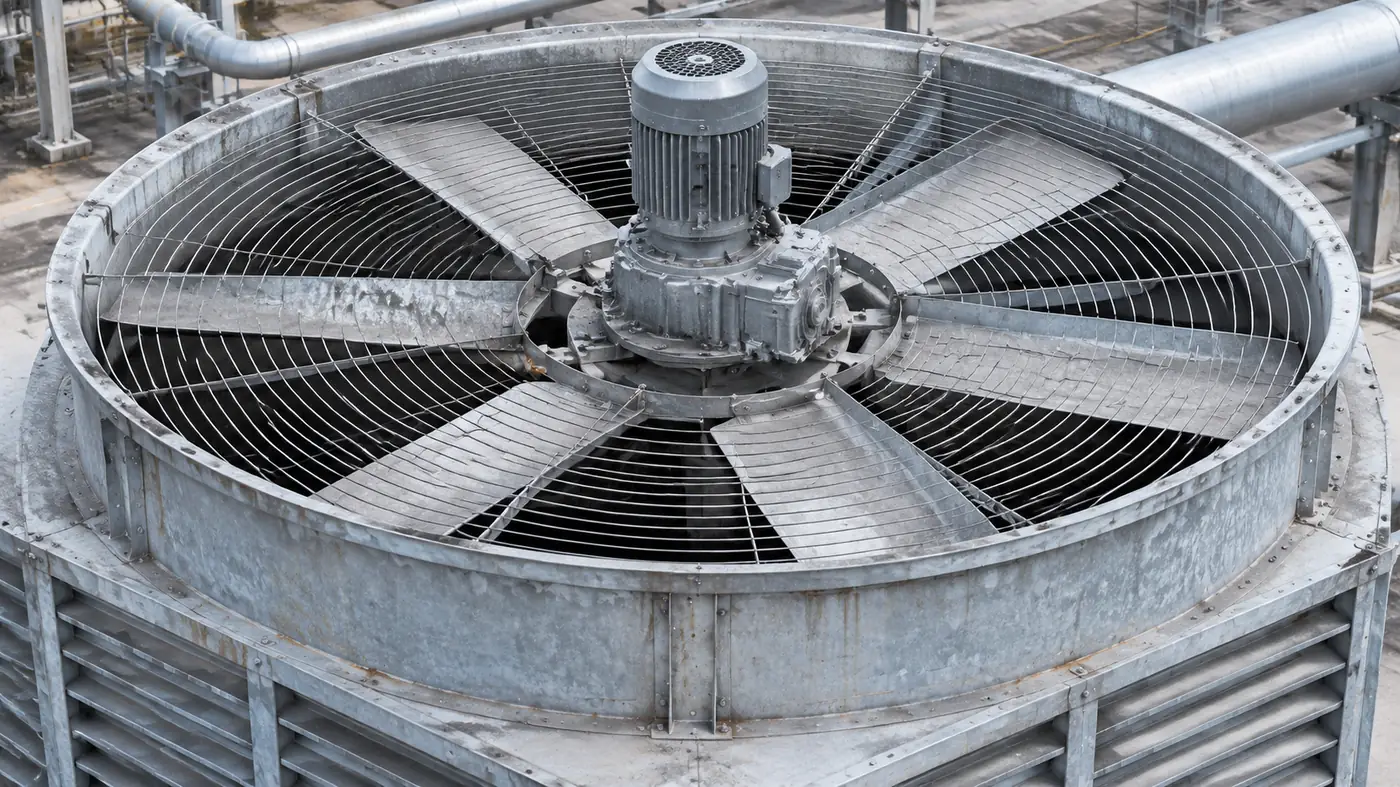
The fan deck of an induced-draught cooling tower: axial fan, hub gearbox and drive motor inside the shroud.
Many cooling towers use axial fans, but the actual fan design must be confirmed from the equipment documentation. The fan curve, blade pitch, transmission and operating point influence the load. The MPCB should be selected from the motor and circuit data, not from a generic assumption about cooling tower fan power.
2. Check the Motor Nameplate and MPCB Current Range
For a conventional motor branch, use the motor nameplate as the primary source of electrical data. Record the rated current for the actual supply voltage and connection. Motor power alone is not enough to select an MPCB.
Collect at least the following information:
Rated voltage and connection arrangement
Rated full-load current for the intended supply
Number of phases and supply frequency
Rated power and speed
Duty rating and service-factor information, if provided
Motor manufacturer’s starting and thermal data, where available
Choose an MPCB whose documented adjustable current range includes the required motor setting. Set it according to the motor and device manufacturers’ instructions and the electrical requirements applicable to the installation. Do not use a universal current-setting multiplier for every cooling tower fan motor. For the general method, see the ZK-ELE three-phase MPCB selection guide and the published MPCB current-setting chart; treat the chart as a reference to published model ranges and confirm the exact current datasheet.
Also verify the selected model’s rated voltage and documented short-circuit breaking capacity against the prospective fault level at the installation point. Confirm the exact product model and order code against the latest datasheet before specifying or ordering.
3. Review Continuous Operation and Starting Conditions
Cooling tower fans may run for extended periods during plant operation, but their actual duty depends on the cooling load, ambient conditions and control strategy. Some systems run fans continuously; others stage multiple fans or vary fan speed to meet changing demand.
Confirm the motor duty, expected starts per hour, acceleration time and control sequence. For direct-on-line (DOL) starting, check the motor’s starting current and the fan manufacturer’s permitted starting conditions. If a contactor provides remote or automatic switching, verify the MPCB-contactor combination using the manufacturers’ coordination information for the exact devices. The three-phase motor starter with overload protection guide covers the wider starter arrangement.
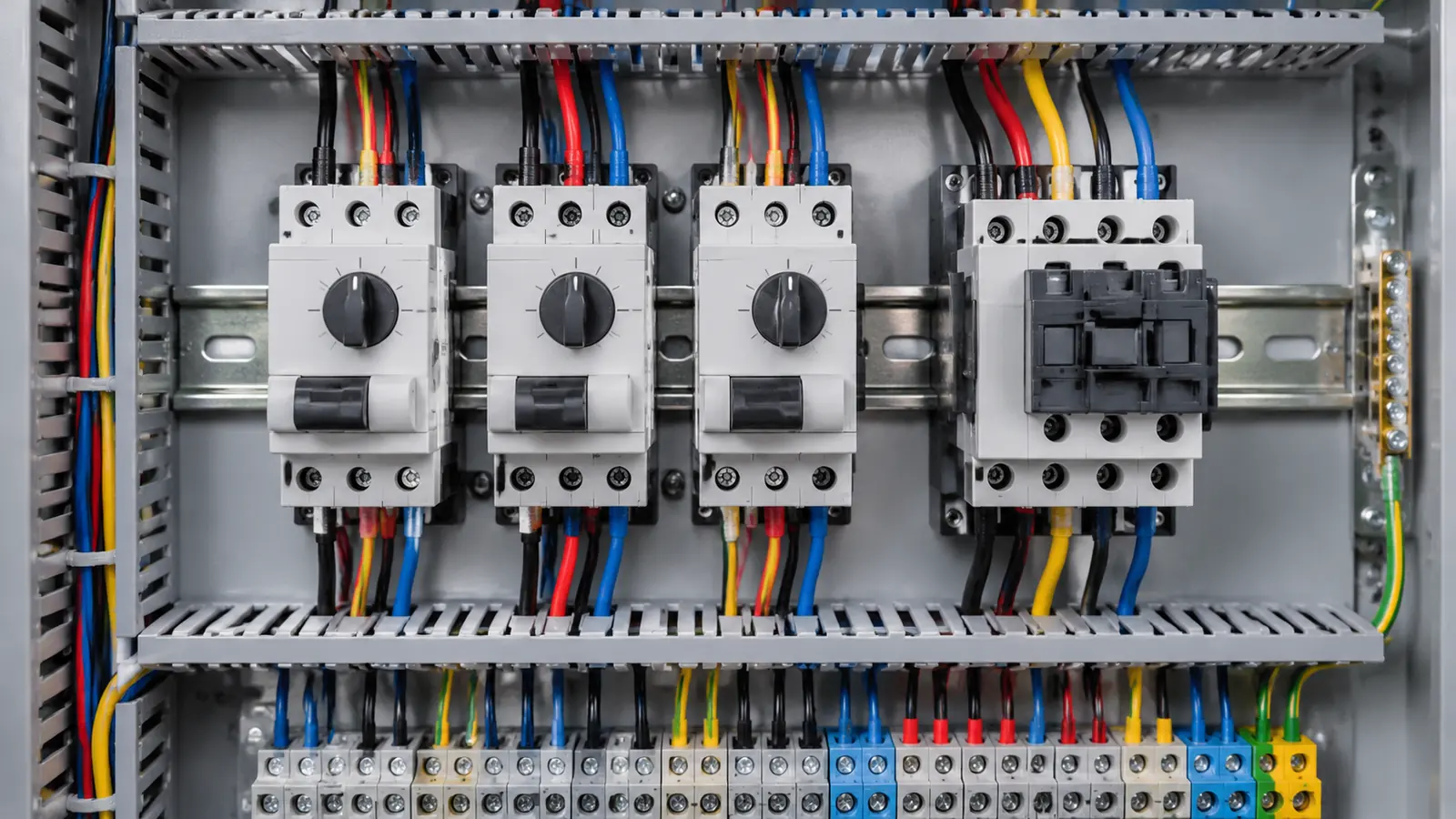
Motor protection circuit breakers and a contactor in a panel. An example of a conventional DOL branch, not a wiring diagram.
Do not increase the overload setting simply to prevent trips during startup or hot-weather operation. Repeated tripping may indicate incorrect device selection, unsuitable settings, excessive starts, abnormal mechanical load, voltage problems or a motor cooling issue. Diagnose the cause using measured current, motor data and the equipment manufacturer’s instructions.
4. Consider VFD Speed Control
A VFD may be used to adjust cooling tower fan speed as cooling demand changes. Speed control can form part of the tower’s operating strategy, but the actual control method depends on the tower design, motor, VFD and system controller.
When a VFD is used, follow the drive manufacturer’s instructions for input-side short-circuit protection, motor overload functions, cable arrangement and any permitted output-side devices. Do not install a conventional MPCB on the VFD output unless the drive manufacturer explicitly permits that arrangement and provides application guidance.
Confirm which device or function protects the motor against overload, where the branch-circuit protective device is installed and how the VFD responds to faults. Do not assume that an external MPCB and the VFD duplicate or replace one another in every design.
For multiple cooling tower fans, check whether each motor has an individual drive or whether the control system uses another arrangement. The protection strategy must match the actual one-line diagram and the manufacturer’s instructions.
5. Check the Mechanical Drive: Direct, Belt or Gearbox
The motor may drive the fan directly, through belts or through a gearbox. Each arrangement has different maintenance and mechanical-monitoring considerations.
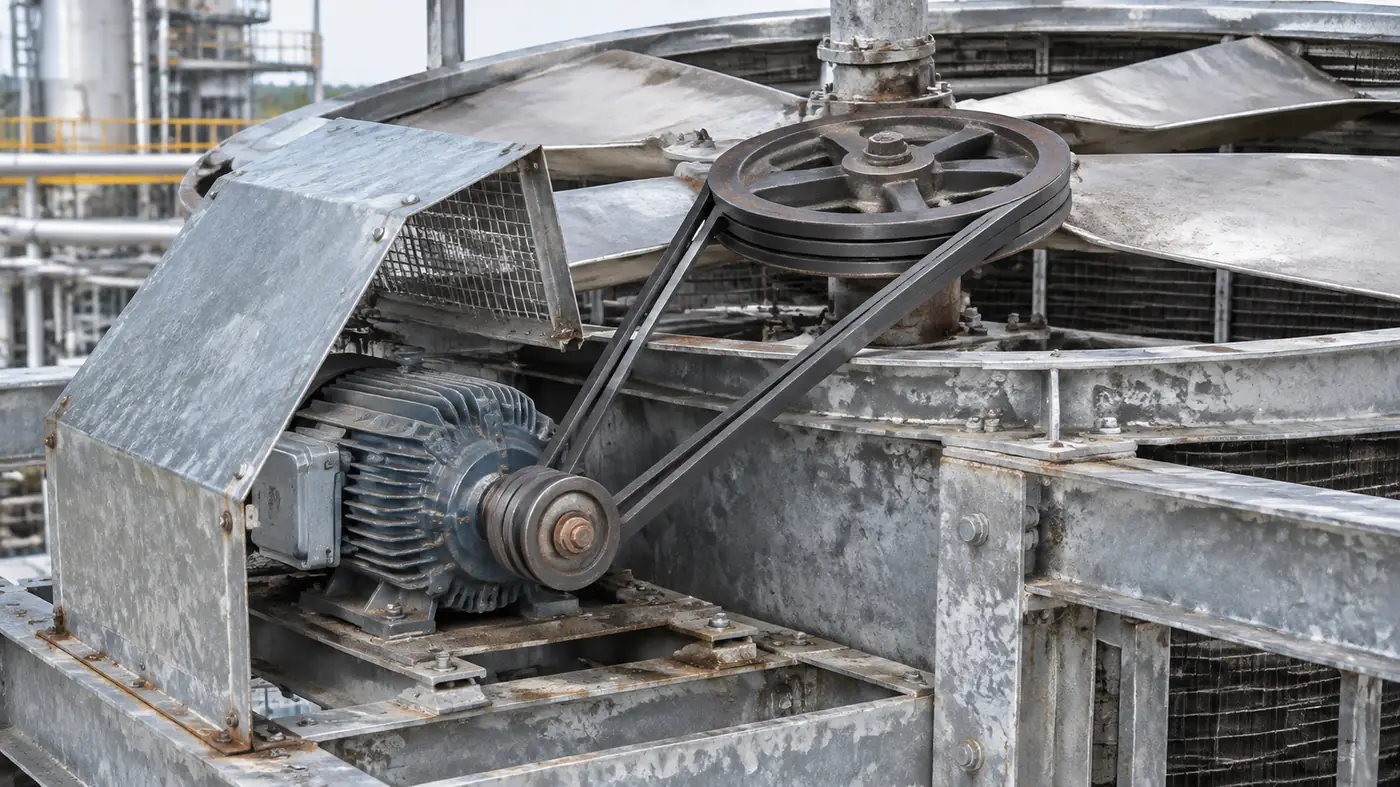
A belt-driven fan: motor pulley, V-belts and fan pulley. Belt condition is a maintenance item; the MPCB protects the motor, not the transmission.
Direct-drive fan
For a direct-drive arrangement, confirm the motor and fan speed requirements, mounting method and any vibration limits specified by the equipment manufacturer. Check that the motor is suitable for the actual operating and environmental conditions.
Belt-driven fan
For a belt-driven fan, review belt tension, alignment, wear and the manufacturer’s maintenance requirements. Belt slip or mechanical deterioration may affect fan performance, but an MPCB is not a belt-condition or fan-speed monitoring device.
Gearbox-driven fan
For a gearbox-driven fan, check the gearbox ratio, rated input power, lubrication requirements and permitted operating conditions. Where the equipment design requires it, use separate oil-temperature, vibration or condition-monitoring devices. An MPCB does not directly measure gearbox oil temperature or detect every mechanical fault.
6. Assess Moisture, Water Drift and Corrosive Exposure
Cooling towers operate around circulating water and may expose nearby equipment to high humidity, water drift, rain, condensation or chemical treatment residues. Coastal or industrial locations may introduce additional corrosion risks.
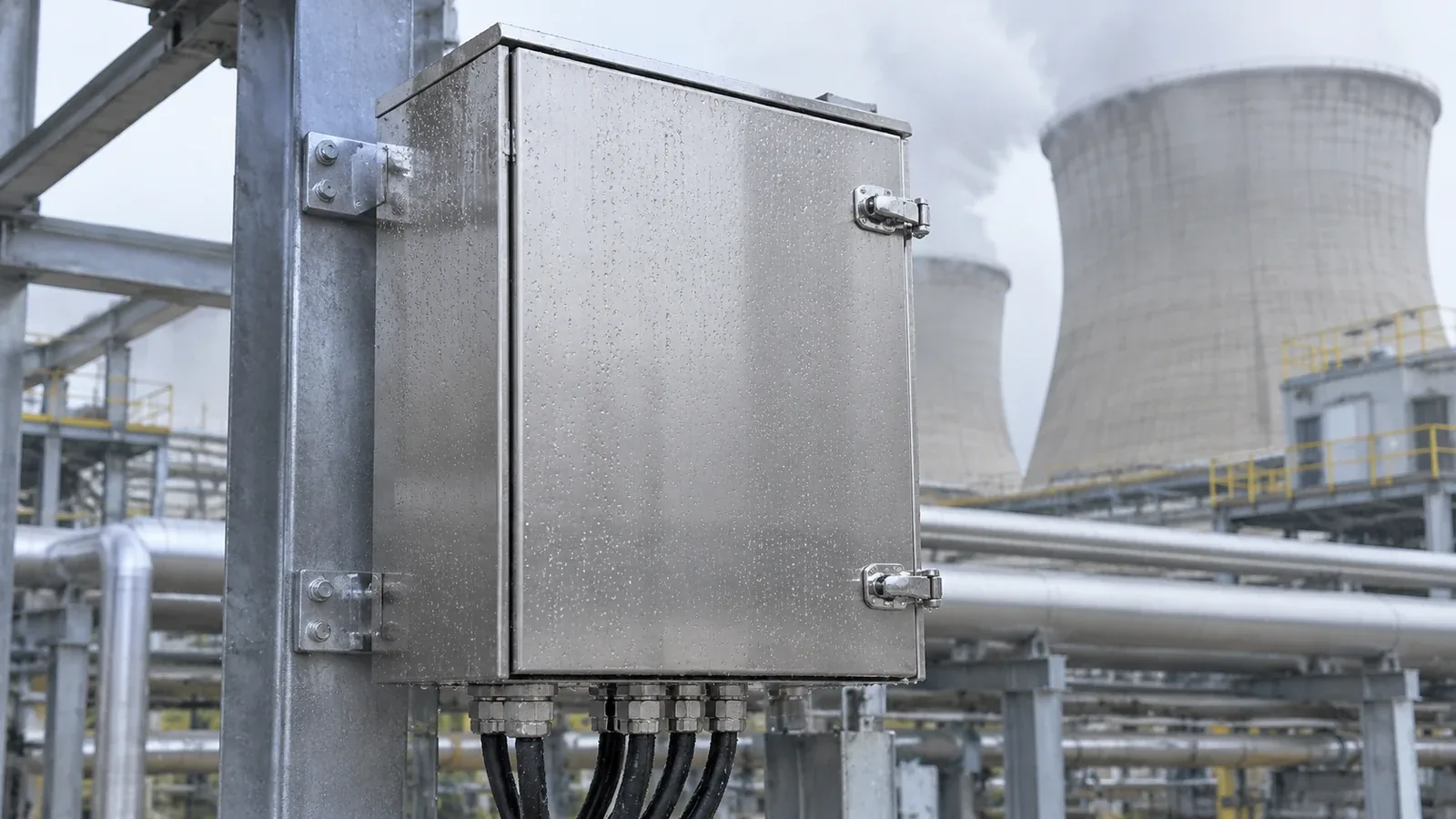
Control equipment in a weatherproof enclosure at a cooling tower plant. The protection belongs to the complete assembled enclosure, not to the devices inside it.
Review the actual location of the motor, MPCB, contactor and control panel. Where practical, electrical control equipment may be installed in a suitable protected enclosure or location rather than exposed directly to spray or runoff. The enclosure, cable entries, ventilation, condensation control and mounting arrangement must be appropriate for the installation.
Do not assume that an MPCB itself is waterproof or corrosion-resistant because it is installed inside an enclosure. Check the product’s own documentation and the rating of the complete assembled enclosure. An enclosure IP rating does not automatically become the rating of each component inside it.
Also consider ambient temperature, ventilation, terminal condition, conductor sizing and the panel manufacturer’s permitted operating conditions. Environmental suitability must be assessed for the complete assembly.
7. Separate Motor Protection from Cooling Tower Monitoring
A cooling tower control system may need to monitor process and mechanical conditions that are not measured by an MPCB. Assign each required protection or alarm function to the appropriate device. For the device types used in a motor branch, see motor overload protection devices.
Condition
Possible monitoring or protection approach
What an MPCB does not do
Motor overload
MPCB thermal overload function, if documented for the selected model
Requires correct motor data and setting.
Short circuit
MPCB magnetic short-circuit function, subject to documented breaking capacity
Does not remove the need to verify prospective fault current.
Fan vibration or imbalance
Vibration monitoring or equipment-specific shutdown logic
Does not measure vibration or fan balance.
Gearbox oil temperature
Temperature sensor and compatible monitoring/control system
Does not directly monitor gearbox oil temperature.
Cooling-water temperature
Temperature sensors and tower control system
Does not regulate or measure water temperature.
Water level or pump operation
Level, flow or pressure devices as required by the system design
Does not detect water level, flow or pump dry-running conditions.
Fan speed feedback
Speed sensor, VFD feedback or controller signal where required
Does not provide dedicated fan-speed feedback.
The final control response should be defined by the cooling tower OEM or system designer. An MPCB trip may stop the fan motor, but it does not decide how the cooling process should respond or replace the tower’s alarms, interlocks and process-control functions.
8. Verify Short-Circuit Capacity and Starter Coordination
Overload protection and short-circuit protection are separate design checks. Confirm the prospective short-circuit current at the installation point and verify that the selected MPCB’s documented breaking capacity is suitable for the system voltage and fault level.
If the MPCB is paired with a contactor and upstream protective device, consult the manufacturer’s coordination tables for the exact combination. Verify the required coordination type, voltage, current range and any specified upstream fuse or circuit breaker. Do not claim Type 1 or Type 2 coordination unless the exact combination is documented.
Check the contactor’s utilization category, rated operational current, control voltage and switching frequency. For a VFD-based arrangement, follow the drive manufacturer’s required protective-device and coordination instructions. The complete motor starter and panel design must comply with applicable installation requirements.
Cooling Tower Fan Motor Protection: Selection Checklist
Use the following list when you specify an MPCB for cooling tower fan motor projects, so that the motor data, drive arrangement and installation conditions are collected before a model is selected.
Cooling tower type, manufacturer and model
Fan type, rated speed and fan performance data, where available
Motor nameplate photo and rated current at the actual supply voltage
Supply voltage, phase, frequency and motor connection
Direct-drive, belt-drive or gearbox arrangement
Starting method: DOL, soft starter or VFD
Expected operating duty, starts per hour and acceleration time
Whether fans operate continuously, seasonally or in stages
Required MPCB current range and exact model for the individual motor branch
Prospective short-circuit current and required breaking capacity
Contactor, upstream protection and coordination information
VFD model and manufacturer protection instructions, if applicable
Panel location, humidity, water drift, condensation and corrosion exposure
Vibration, gearbox temperature or other separate monitoring requirements
Quantity, destination market and technical documentation requirements
Conclusion
Selecting an MPCB for a cooling tower fan motor starts with the motor nameplate and the actual fan-drive arrangement. Confirm whether the fan is direct-driven, belt-driven or gearbox-driven, and whether the motor uses DOL starting, a soft starter or a VFD.
The selected MPCB must have a suitable documented current range, voltage rating and short-circuit breaking capacity for the individual motor branch. Cooling tower moisture, water drift, condensation and corrosion also require attention to the motor location, control panel and complete enclosure.
An MPCB does not replace vibration monitoring, gearbox temperature sensing, water-temperature control or other cooling tower process functions. For cooling tower OEMs, panel builders and project buyers, sharing the motor nameplate, fan data and control arrangement helps the supplier review suitable MPCB models and available technical documents.
Frequently Asked Questions
Can an MPCB be used for a cooling tower fan motor?
An MPCB may be suitable for an individual conventional motor branch when its documented current range, voltage, breaking capacity and other ratings match the application. Confirm the motor nameplate, starting method, circuit fault level and complete starter arrangement.
Does a cooling tower fan motor need special protection because of humidity?
Humidity does not by itself determine the MPCB model. It does make the installation environment important. Review the motor location, control-panel enclosure, cable entries, condensation risk, corrosion exposure and the product documentation for the selected components.
Can I use an MPCB with a VFD-controlled cooling tower fan?
The required protective device and its location depend on the VFD manufacturer’s instructions. Verify the input-side protection and whether any output-side device is permitted. Do not assume a conventional MPCB can be installed on every VFD output.
Should a cooling tower fan motor run continuously?
Operating duty depends on the cooling tower design and plant cooling demand. Check the motor duty rating, OEM operating instructions, control sequence and expected starts per hour rather than assuming every installation uses the same schedule.
Can an MPCB detect fan imbalance or gearbox problems?
An MPCB is a motor-circuit protection device, not a vibration or gearbox-condition monitor. Use suitable vibration, speed or temperature monitoring where the equipment design requires those functions.
What information should I send a supplier for a cooling tower fan MPCB recommendation?
Provide the motor nameplate, supply voltage, rated current, fan and drive arrangement, starting method, VFD details, operating duty, available fault level, installation environment, required quantity and destination market.
Need Motor Protection for Your Cooling Tower Project?
Share your cooling tower fan motor details and control arrangement with ZK-ELE. Our team can review the information, check the available MPCB models for a suitable conventional motor branch and confirm which product specifications and supporting documents are available for your project. If you are comparing an MPCB for cooling tower fan motor duty across several tower models, include the fan data for each one.
For a more accurate review, include:
Motor nameplate photo and rated current
Cooling tower model and fan type
Direct-drive, belt-drive or gearbox details
Starting method and VFD information
Operating duty and expected starts per hour
Panel location and environmental conditions
Required quantity and destination country
OEM branding, packaging or documentation requirements, if applicable
Packaging machines can contain several motors with different operating cycles. Learn how to assess motor current, frequent starts, separate motor branches, VFDs and servo-drive protection before specifying an MPCB.
Industrial mixers can face changing torque and starting conditions as material viscosity, batch size and process temperature change. Learn how to assess motor current, starting duty, VFD arrangements and protection coordination before specifying an MPCB.
Selecting motor protection for an HVAC fan requires more than matching motor power. Learn how to check fan type, motor current, starting method, VFD requirements and control-panel coordination.