How to Select an MPCB for a Packaging Machine Motor
Published: Author: Rachel
Industrial packaging machines often combine several operations in one production line: feeding, conveying, filling, wrapping, sealing, capping, labeling and case packing. A machine may contain multiple motors, each with a different load profile and operating cycle. Some run continuously, while others start, stop, index or reverse as the machine completes each production sequence.
This makes motor protection an application-specific task. Choosing a motor protection circuit breaker (MPCB) by motor power alone can overlook starting frequency, operating duty, the number of independent motor circuits and the control method used by each axis.
This guide explains how packaging-machine OEMs, electrical panel builders, automation integrators and industrial buyers can assess whether an MPCB is appropriate for a conventional motor branch and what information should be confirmed before selecting a model.
What Does an MPCB Do in a Packaging Machine?
An MPCB is a motor-circuit device that provides the switching and protection functions stated in its technical documentation. Depending on the exact model, these commonly include adjustable thermal overload protection and magnetic short-circuit protection. The actual current range, rated voltage, breaking capacity, pole configuration and other functions must be checked for the specific model and order code.
In a packaging machine, an MPCB may be considered for a suitable individual motor branch, such as a conventional three-phase induction motor driving a conveyor, feeder, pump, fan or other mechanism. It is not automatically suitable for every electrical load inside the machine.
An MPCB does not replace machine guarding, emergency-stop circuits, safety interlocks, light curtains, jam sensors, temperature controllers or process controls. These functions address different hazards and operating conditions and must be designed separately in accordance with the machine risk assessment and applicable requirements.
1. Map the Machine’s Motor Circuits Before Selecting a Device
Start by reviewing the machine layout and electrical schematic. A packaging line may include several motor-driven mechanisms, and they should not be treated as one undifferentiated load.
Typical motor-driven sections may include:
Infeed and outfeed conveyors
Product metering or feeding mechanisms
Film unwind, web handling or roll feeding systems
Filling, dosing or auger mechanisms
Capping, labeling or carton-handling drives
Case packers, palletizers or transfer mechanisms
Cooling fans, extraction fans or auxiliary pumps
For each motor, record its function, motor type, rated current, control method, duty cycle and required starting or stopping behavior. This motor-by-motor inventory helps identify which branches may use a conventional MPCB and which require a different protection arrangement.
2. Check the Motor Nameplate and Required Current Range
For a conventional motor branch, the motor nameplate is the primary source for the electrical data needed to assess the MPCB. Record the rated current for the actual supply voltage and connection. Do not choose a device solely from the motor’s kilowatt or horsepower rating.
Collect at least the following information:
Rated voltage and connection arrangement
Rated full-load current for the intended supply
Number of phases and supply frequency
Rated power and speed
Duty rating and service-factor information, if provided
Motor manufacturer’s starting and thermal data, where available
The selected MPCB must have a documented adjustable current range that includes the required motor setting. Set the device according to the motor and device manufacturers’ instructions and the electrical requirements applicable to the installation. Do not apply one universal setting multiplier to all packaging-machine motors.
3. Account for Frequent Starts, Stops and Intermittent Duty
Packaging machinery often operates in repeated production cycles. A conveyor may run continuously while a dosing or indexing motor starts and stops repeatedly. A machine may also use jogging or inching during setup, cleaning or changeover.
Frequent starting can increase motor heating and place additional demands on contactors and switching components. Before selecting protection, obtain the expected starts per hour, acceleration time, operating duration, rest periods and any manufacturer-defined duty limits.
The protection arrangement must accommodate the documented motor starting conditions while maintaining the required overload and short-circuit protection. Do not increase an overload setting simply to prevent nuisance trips. Repeated trips should trigger an investigation of the mechanical load, motor condition, control sequence, starting method and device suitability.
4. Consider the Type of Motor and Drive
Conventional three-phase induction motors
A conventional three-phase induction motor used for a conveyor, feeder, fan or pump may be a candidate for an MPCB when the selected device’s ratings and functions match the branch circuit. Check nameplate current, starting method, operating duty, short-circuit level and the complete starter arrangement. The motor protection circuit breakers range lists the models available for these branches.
VFD-controlled motors
Some packaging-machine motors use a variable frequency drive to control speed, acceleration, deceleration or synchronization. Follow the VFD manufacturer’s instructions for input-side protection, motor overload protection and any permitted output-side devices. Do not install a conventional MPCB on a VFD output unless the drive manufacturer explicitly permits that arrangement and provides application guidance.
Servo and stepper motor axes
Servo and stepper systems are commonly controlled by dedicated drives. Their power circuits, electronic protection and fault behavior differ from a direct-on-line induction motor branch. Use the servo or stepper drive manufacturer’s specified branch-circuit protection and wiring instructions. An MPCB may be considered upstream only where the drive manufacturer and the approved electrical design permit the exact device type and arrangement. Do not place an MPCB between a servo drive and its motor unless the drive manufacturer specifically requires or allows it.
The practical rule is to identify the motor and drive first. Do not assume that every motor in a packaging machine should use the same protective device.
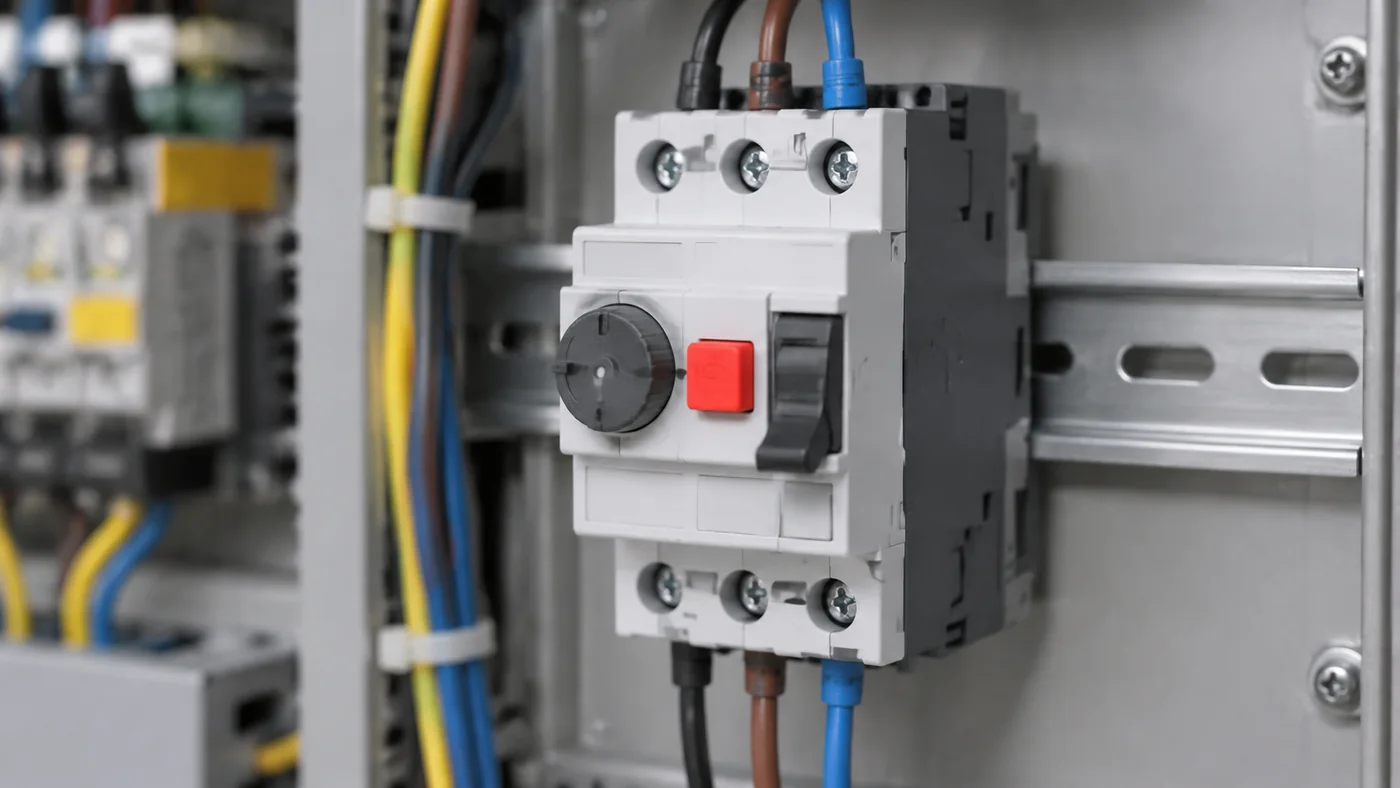
Illustrative close-up of a motor protection circuit breaker on DIN rail: adjustable current dial, trip indicator and manual on/off positions. Confirm the rated current range and terminal arrangement on the datasheet for the exact model before ordering.
5. Design Protection for Multiple Independent Motor Branches
A packaging machine may contain several motors with different rated currents and operating duties. Each branch should have a clearly defined protection strategy that matches its motor and circuit.
Do not assume that one MPCB can provide suitable overload protection for multiple motors connected in parallel. In many standard machine designs, each motor branch needs its own appropriately selected overload protection. Any group-motor or shared-protection arrangement must be engineered and verified against the applicable standards, conductor protection requirements, device ratings and manufacturer instructions.
Separate motor branches can also make fault isolation and maintenance more straightforward. The electrical schematic should clearly identify the protective device, switching device, motor and control logic for each branch.
6. Check the Starter and Contactor Arrangement
A packaging machine may use local manual operation, contactor-based DOL starting, soft starters or VFDs. The required control method determines which switching components are needed.
Where an MPCB is paired with a contactor, verify the manufacturer’s coordination information for the exact combination. Check the contactor’s utilization category, rated operational current, control voltage and expected switching frequency. Do not assume that components are coordinated simply because their nominal current ratings appear similar. For the starter arrangement rather than the device alone, see three-phase motor starter with overload protection.
For automatic sequencing, PLC control or remote start/stop, the contactor or drive normally performs the commanded switching function according to the approved circuit design. The MPCB’s role and location should be clear in the schematic.
7. Understand the Limits of Motor Protection
A packaging machine can experience mechanical and process faults that do not necessarily produce a predictable motor-current response. An MPCB should not be treated as a universal machine fault detector.
Machine condition
Possible detection or protection approach
Important limitation
Motor overload
MPCB thermal overload function, if documented for the selected model
Correct motor data and setting are essential.
Short circuit
MPCB magnetic protection, subject to its documented breaking capacity
Verify prospective fault current and system voltage.
Product jam or blocked mechanism
Machine-specific jam, torque, position or process sensors
A jam does not always create a predictable current rise.
Film or web break
Web-tension, presence or process sensors as specified by the machine design
MPCB is not a web-break detector.
Guard door opened or operator hazard
Safety interlock and safety-related control system
Do not use an MPCB as a substitute for machine safety functions.
Heater or temperature-control fault
Dedicated branch protection, temperature controller and safety cut-out as required
An MPCB is intended for motor circuits, not as a general heater protector.
This distinction is important for both machine safety and uptime. Assign each fault-detection task to the appropriate electrical protection, process sensor or safety system. For a comparison of the device types used in a motor branch, see motor overload protection devices.
8. Verify Short-Circuit Capacity and Installation Conditions
Overload protection and short-circuit protection are separate checks. Confirm the prospective short-circuit current at the point of installation and verify that the selected MPCB’s documented breaking capacity is suitable for the system voltage and fault level.
Also review ambient temperature, panel temperature rise, ventilation, mounting orientation, conductor sizing, terminal requirements, vibration and contamination. For a machine installed in a washdown or dusty environment, verify the rating of the complete enclosure and the installed components. Do not assume an IP rating for an MPCB unless its own documentation states it.
Packaging Machine Motor Protection: Selection Checklist
Machine type and process description
Electrical schematic and motor list
Motor nameplate photo for each relevant motor
Rated voltage, current, phase and frequency
Motor type: induction, servo, stepper or integrated motor-drive assembly
Starting method: DOL, soft starter or VFD / servo drive
Expected starts per hour, acceleration time and operating duty
Which motors run continuously and which operate intermittently
Required MPCB adjustment range and exact model for each suitable motor branch
Prospective short-circuit current and required breaking capacity
Contactor, upstream protection and coordination information
Separate process and machine-safety devices required
Quantity, destination market and technical documentation requirements
Conclusion
Selecting an MPCB for a packaging machine motor starts with understanding the machine’s motor list and control architecture. Identify each motor, check its nameplate current and duty, assess frequent starts and confirm whether the branch uses a conventional starter, VFD or dedicated servo drive.
An MPCB may be suitable for a correctly specified individual motor branch, but it does not replace process sensors or machine safety systems. For multi-motor machines, verify the protection and coordination of each branch rather than assuming one device can protect the entire machine.
For packaging-machine OEMs, panel builders and distributors, preparing the motor list and electrical schematic before requesting a quotation helps the supplier review the available product models and identify which technical documents are needed.
Frequently Asked Questions
Can an MPCB be used in a packaging machine?
An MPCB may be suitable for an individual conventional motor branch when its documented current range, voltage, breaking capacity and other ratings match the application. It is not automatically suitable for every servo, stepper, heater or auxiliary circuit in the machine.
Does each motor in a packaging machine need its own MPCB?
Each motor branch needs a protection strategy appropriate to its motor and circuit. A dedicated MPCB may be used for a suitable individual branch. Shared or group-motor protection must be specifically engineered and verified; do not assume one MPCB protects several motors correctly.
Can an MPCB protect a servo motor?
Servo motors are normally supplied through dedicated servo drives. Follow the drive manufacturer’s instructions for branch-circuit protection and device placement. Do not install an MPCB between the servo drive and motor unless the manufacturer explicitly permits it.
Can I use an MPCB with a VFD-controlled packaging motor?
The permitted protective device and its location depend on the VFD manufacturer’s instructions. Verify the required input-side protection and whether any output-side device is allowed. Do not assume a conventional MPCB can be installed on every VFD output.
Will an MPCB detect a jam in a packaging machine?
It may trip if the jam causes electrical conditions that reach its trip characteristics, but not every jam produces a predictable current rise. Use suitable torque, position, presence or process sensors when the machine needs reliable jam detection.
What information should I send a supplier for an MPCB recommendation?
Provide the machine type, electrical schematic, motor list, motor nameplate data, supply voltage, starting method, VFD or servo-drive details, operating cycle, required quantity and destination market. Identify which individual motor branch you want the supplier to review.
Need Motor Protection for Your Packaging Machine?
Share your packaging-machine motor list and electrical schematic with ZK-ELE. Our team can review the information, check the available MPCB product range for suitable motor branches and confirm which model specifications and supporting documents are available.
For a more accurate review, include:
Machine type and application
Motor list and nameplate photos
Supply voltage and motor rated current
Starting method and VFD or servo-drive details
Expected operating cycle and start frequency
Required quantity and destination country
OEM branding, packaging or documentation requirements, if applicable
Industrial mixers can face changing torque and starting conditions as material viscosity, batch size and process temperature change. Learn how to assess motor current, starting duty, VFD arrangements and protection coordination before specifying an MPCB.
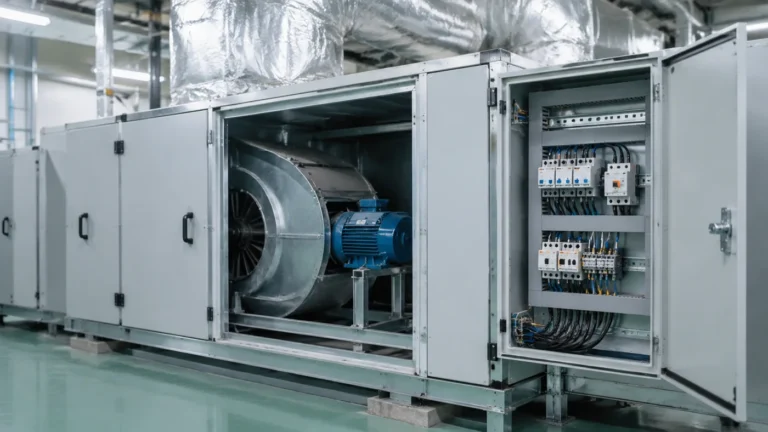
Selecting motor protection for an HVAC fan requires more than matching motor power. Learn how to check fan type, motor current, starting method, VFD requirements and control-panel coordination.
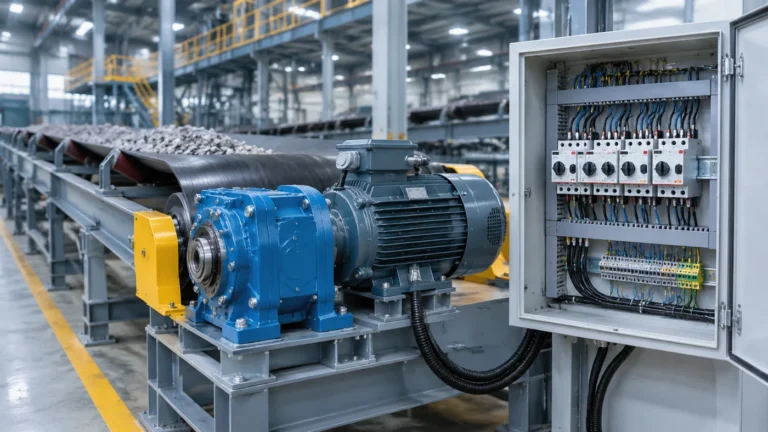
Conveyor motor protection depends on more than rated power. Learn how to assess starting load, belt jams, motor current, drive arrangements and protection coordination.