3-Phase Motor Full Load Current Chart (400 V / 415 V)
Full load current chart for standard 3-phase motors, 0.37-75 kW at 400 V and 415 V - with overload setting and the recommended MPCB model for each rating.
Read More
MPCB, MCB, and MCCB all disconnect faulty circuits, but they protect different things. In short: an MCB protects cables and final circuits with a fixed trip curve, an MCCB protects feeders and distribution with higher ratings and adjustable trips, and an MPCB is built around a single motor — with an adjustable overload dial, magnetic trip tuned to starting current, and phase-loss protection. The main difference is not current rating; it is the type of load each device is designed to protect.
This guide compares the three side by side, explains why an MCB cannot simply replace an MPCB on a motor circuit, and shows how they work together in a motor control center.
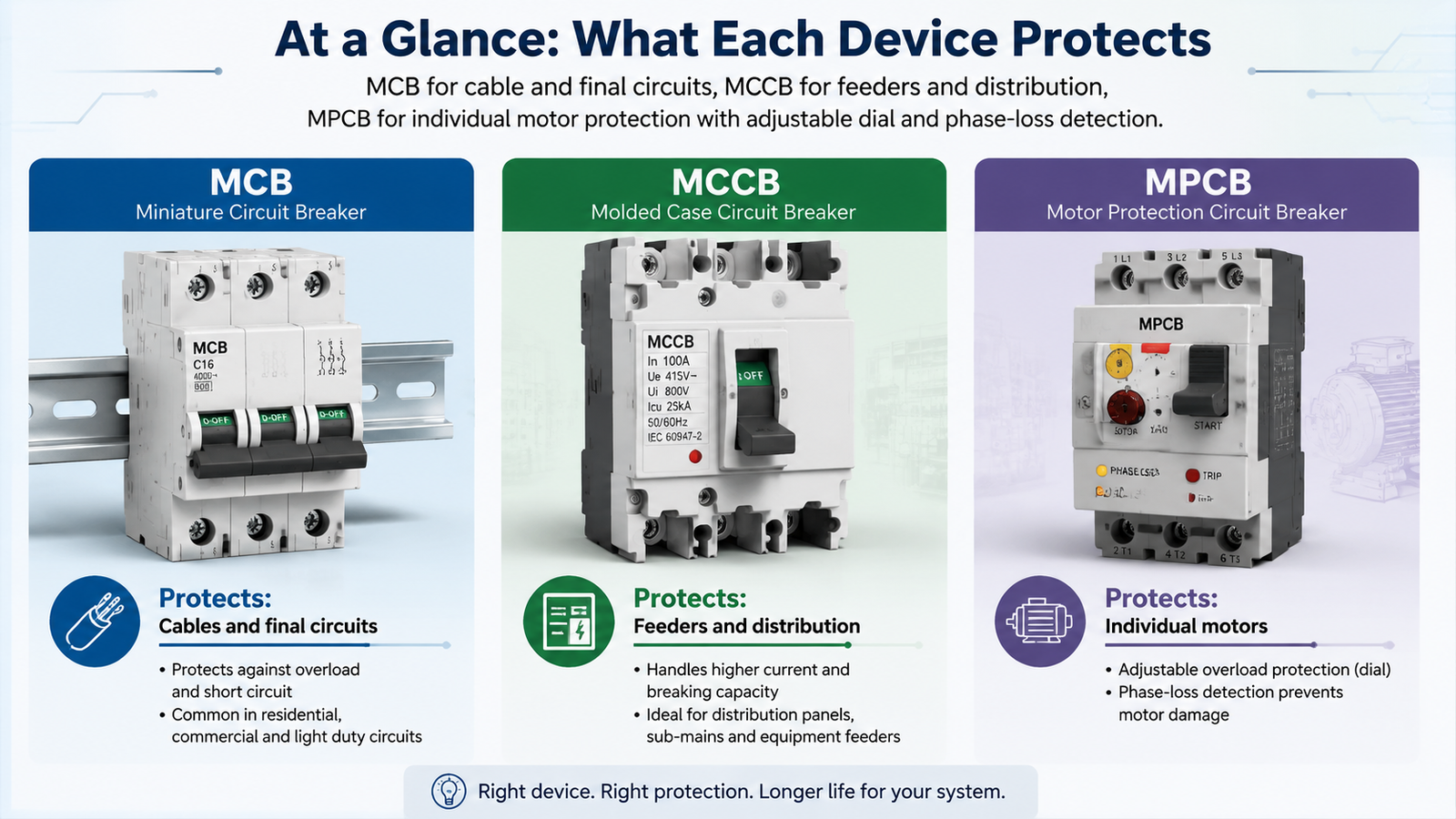
| Feature | MPCB | MCB | MCCB |
|---|---|---|---|
| Primary purpose | Individual motor protection | Cable and final-circuit protection | Feeder and distribution protection |
| Applicable standard | IEC 60947-4-1 | IEC 60898-1 | IEC 60947-2 |
| Typical current range | Up to ~100 A per motor branch | 0.5–100 A | 16 A to 1000 A+ |
| Overload setting | Adjustable dial to motor FLA | Fixed trip rating | Fixed or adjustable trip unit |
| Tolerates motor starting inrush | Yes — designed for it | Not specifically | Only with suitable settings |
| Phase-loss protection | On many models | Normally no | Requires a suitable trip unit or relay |
| Manual motor switching | Yes | No | No (switching, not starting duty) |
| Typical application | Pumps, fans, compressors, machinery | Lighting, sockets, small circuits | Large motors, feeders, main panels |
| Extra overload relay needed for motor duty | Usually not | Normally required | Often required unless motor-specific trip unit |
For a deeper look at just the two motor-protection devices, see our dedicated MPCB vs MCCB comparison.
An MCB’s thermal and magnetic elements track the ampacity of the cable it protects, with fixed B/C/D trip curves for wiring duty. On a motor circuit this creates a conflict: an MCB rated at the motor’s full-load current may trip during the starting inrush of a direct-on-line start, while an MCB oversized to tolerate that inrush will not protect the winding from a sustained overload.
An MCB can still be part of a motor starter — ahead of or combined with a contactor and a separate thermal overload relay — but it should never be treated as a replacement for an MPCB. The thermal curve, magnetic threshold, and coordination data behind an MCB are built for cables, not for a motor’s starting and running behavior.
MCCBs offer higher current ratings, stronger breaking capacity, and more adjustment options than MCBs. They are the right device for feeder protection, main incomers, and installations with high prospective fault current — including large motors (typically above the MPCB frame range) and groups of motors on one feeder.
For a single motor within the MPCB range, a general-purpose MCCB means giving up the fine FLA dial and the phase-loss sensitivity of an MPCB. For larger motors, an MCCB is commonly combined with an electronic motor protection relay and contactor. On the other end, using an MPCB in place of an MCCB on a feeder undersizes the device for a load that is not a single motor.
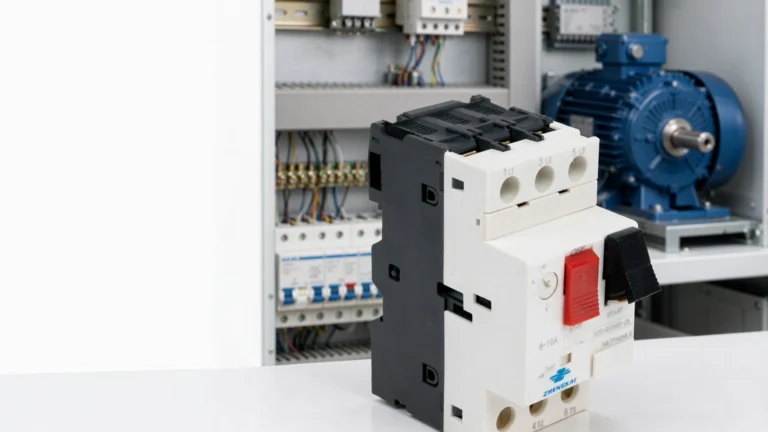
An MPCB combines overload, short-circuit, and phase-loss protection in one device sized around a single motor. Its adjustable thermal dial tracks the motor nameplate current, its magnetic trip sits above the starting inrush so a DOL start does not cause nuisance trips, and many models detect a missing phase. The GV2-M manual starter and protector series covers small and medium motors up to 32 A, while the GV3-M series covers 40–63 A for larger machines.
For how to size the range and set the dial, see how to select an MPCB for a 3-phase motor and the MPCB current setting chart. If you are weighing an MPCB against a contactor-plus-relay starter, MPCB vs thermal overload relay covers the trade-offs.
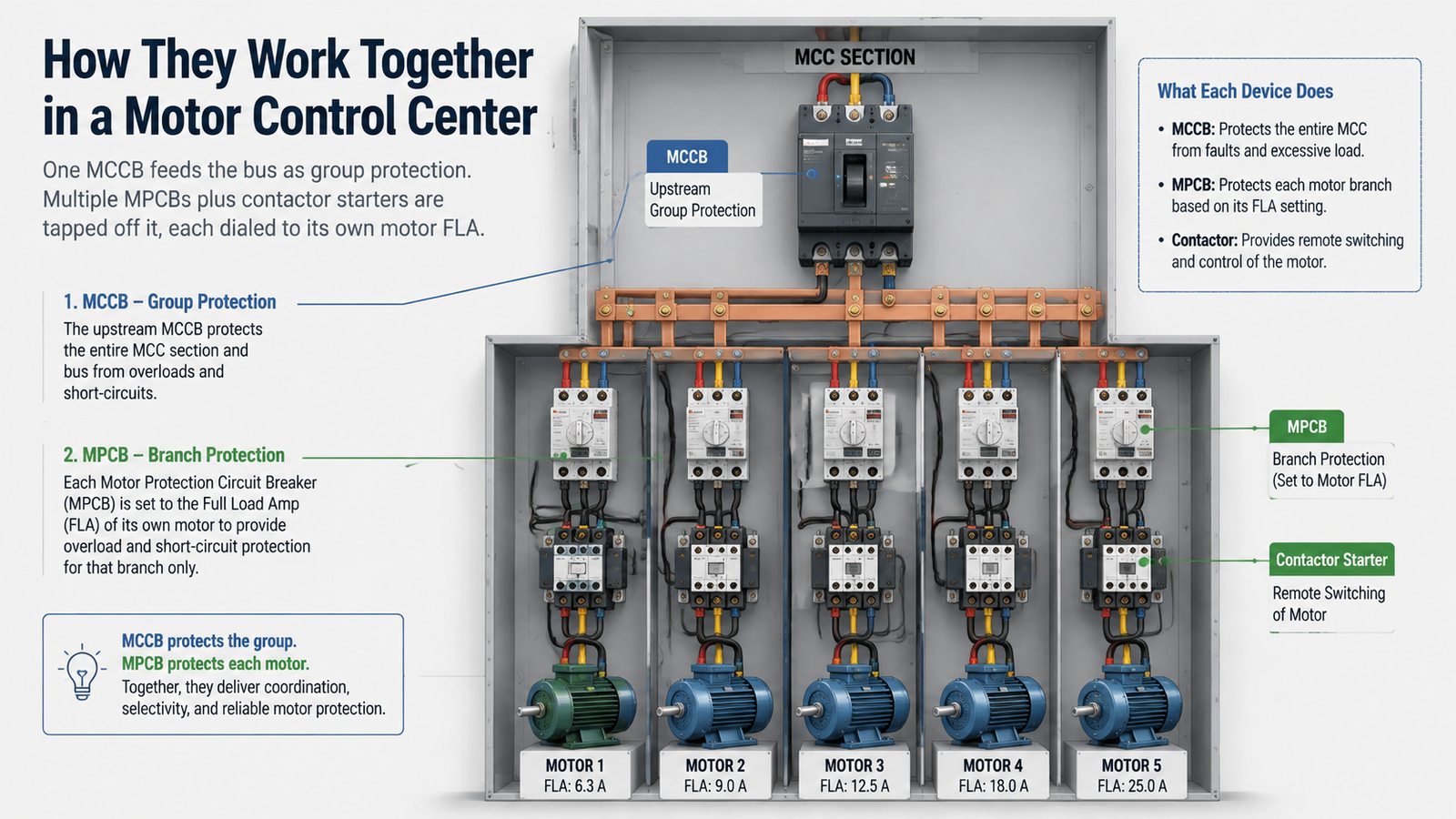
In a typical MCC lineup the three devices are not competitors — they are layers. One MCCB feeds the bus as the group or main protective device, and multiple MPCB-plus-contactor combination starters are tapped off it, each MPCB dialed to its own motor’s full-load current. This is standard practice in industrial panels: MCCB upstream for the feeder, MPCBs downstream for each motor branch, and MCBs for auxiliary circuits such as lighting and control power.
It can provide short-circuit and cable protection, but not complete motor protection. Its fixed curve either trips during starting or leaves the winding underprotected. Use a contactor plus thermal overload relay if an MCB must be used.
Yes, for large motors or feeders — but a general-purpose MCCB lacks the fine FLA dial and phase-loss sensitivity of an MPCB, so it is usually paired with an electronic motor protection relay. Verify motor-specific functions in the product data.
For the same current range, an MPCB is typically more compact and cost-effective than an MCCB when motor protection is the only job. MCCBs earn their cost on feeders and distribution.
MPCBs are normally available in three-pole versions for three-phase motor circuits so all phases disconnect together. Single-phase applications are covered by other devices — see motor overload protection devices for the full context.
The dial sets the thermal overload reference to the motor’s nameplate current and, on many models, the magnetic threshold. An MCB’s characteristics are fixed and set at the factory for cable duty.
MCB, MCCB, and MPCB are different tools for different jobs: MCB for cables and final circuits, MCCB for feeders and distribution, and MPCB for individual motor protection with an adjustable dial, starting-current tolerance, and phase-loss detection. In a motor control center, they work together — an MCCB upstream, MPCBs on each motor branch, and MCBs on auxiliary circuits.
Need the right protection for your application? Browse our MPCB product range and the CM1 MCCB range, or contact us with your load details for a recommendation.